Food · 28 September 2026
Ethiopian Food Guide: How to Order, Eat and What to Try
New to Ethiopian food? How to order, how to eat from the injera, what to taste first and how to build a meal for two or three, with the prices at ge'eza in Dakar.
To try Ethiopian food for the first time, order a dish to share and eat with your fingers. Everything arrives on a large injera, a soft, slightly sour flatbread that you tear to scoop up sauce. The easiest start is a beyaynetu, the platter that brings seven vegan fasting dishes together, plus a meat dish such as tibs or doro wot.
How an Ethiopian meal is built
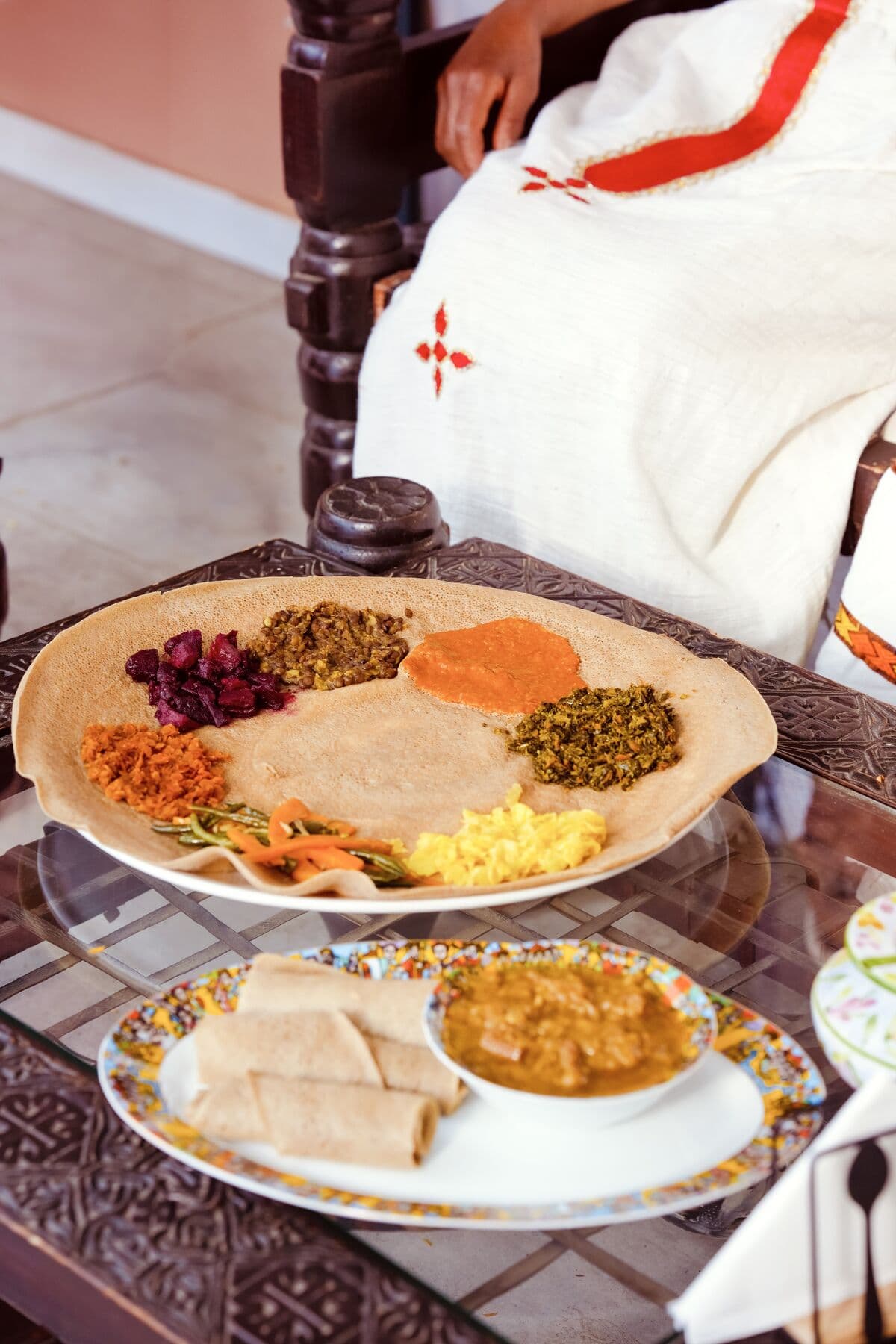
A meal is served on one shared tray. Injera is laid across the bottom, stews and vegetables are placed on top, and extra rolled injera comes on the side. There are no individual plates and no cutlery is required: the bread is both the plate and the tool. People say you eat injera with injera.
A few words are enough to read a menu. A wot is a slow-cooked stew, often built on berbere, the base spice blend. An alicha is a milder version cooked with turmeric. Tibs are pieces of meat sautéed over high heat with onion, tomato and herbs. A firfir is torn injera warmed in a sauce. Kitfo is hand-minced beef, Ethiopia's answer to tartare.
What to taste first
The beyaynetu. This is the best starting point. At ge'eza it gathers Shiro, Misir, Fosolia, Gomen, Key Sir, Tikil Gomen and Alicha Ater Kik on one large injera platter. It comes for 1, 2 or 3 people, from 7,000 F for one. Every dish is vegan, made from pulses and spices, without butter.
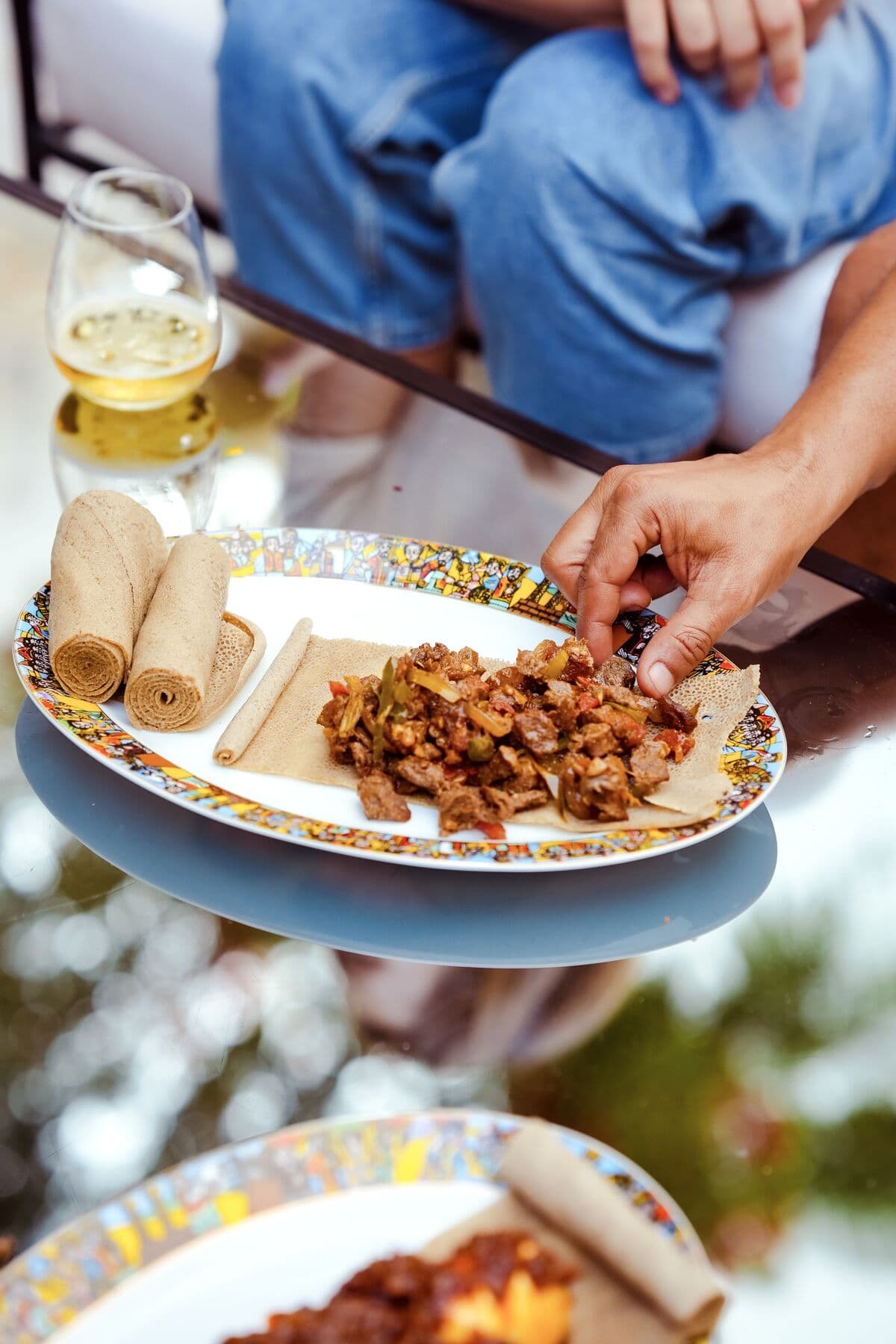
Tibs. Meat sautéed with onions, tomatoes and fresh herbs, 8,000 F. A direct dish that suits palates not used to spice. Derek Tibs, seared until caramelised, is crisp outside and tender inside.
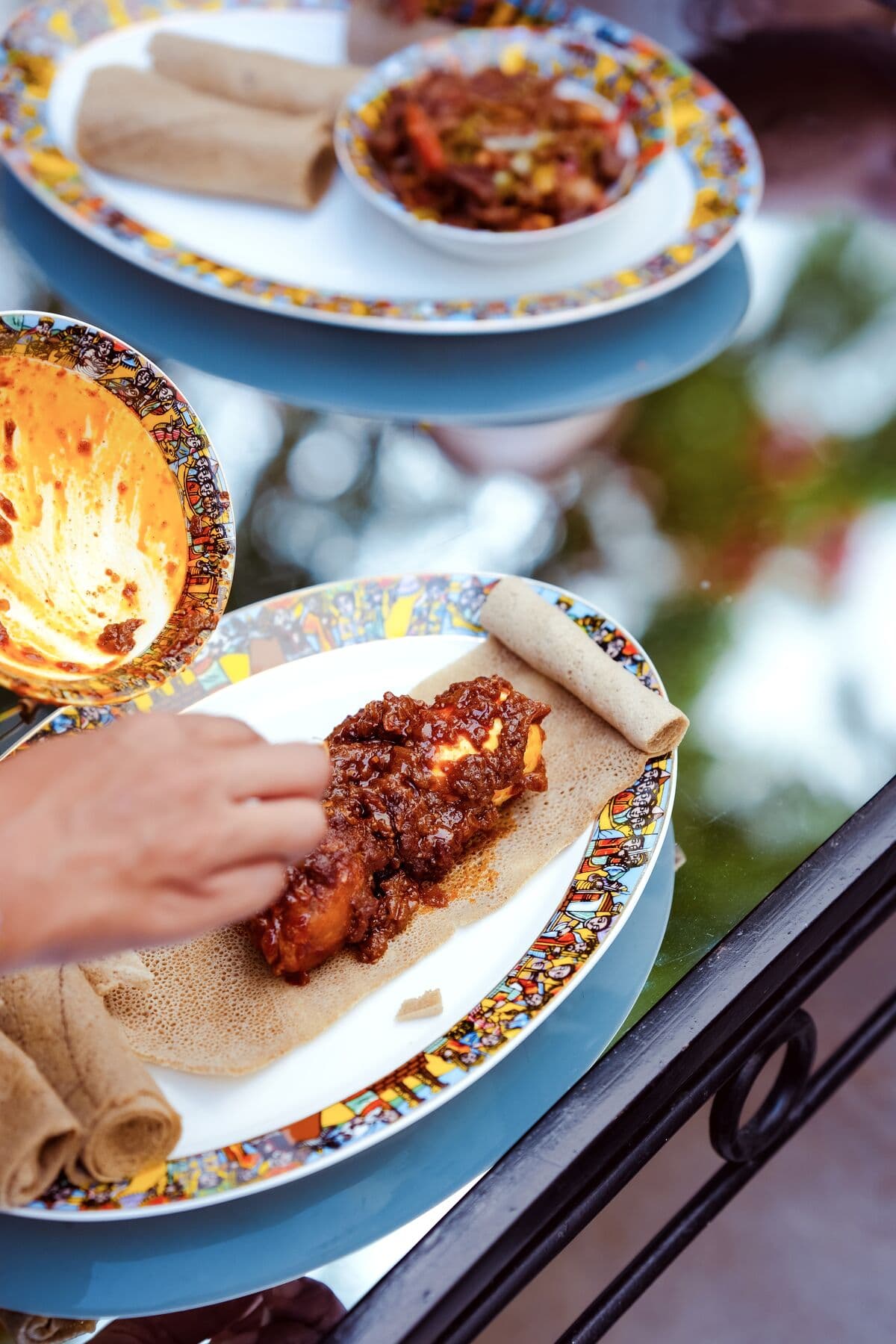
Doro wot. Chicken slow-cooked in clarified butter and served with a hard-boiled egg, 8,000 F. It is Ethiopia's classic celebration dish, and it has its own article: doro wot.
Ye Fisig Beyaynetu. For anyone torn between vegetables and meat: three fasting stews and one meat stew of your choice on the same platter. It is 7,000 F for one person, 10,000 F for two and 16,000 F for three.
How much to order
For two people, one beyaynetu for two, or one meat dish and one vegetarian dish, is usually enough. For three, the beyaynetu for three is the natural choice: it is designed for sharing. Kitfo, at 9,000 F, has to be ordered 24 hours ahead, so tell the team the day before, by phone or WhatsApp at +221 78 660 07 07.
If someone at the table prefers something familiar, the menu also lists pizzas, burgers and, from Tuesday to Friday at lunch, a Senegalese dish of the day at 5,500 F, with a drink and attaya included. A mixed group can share the table without anyone being pushed out of their comfort zone.
How to eat without getting it wrong
Use your right hand. Tear a piece of injera, pick up some sauce or vegetable, fold it into a small parcel and bring it to your mouth. Start from the edges of the tray, where the dishes are easier to reach. The gursha, a mouthful you place in someone else's mouth, is a sign of affection: you can politely decline, but accepting is appreciated. It has its own article: gursha, eating with your hands.
A practical note: the sauce stains fingers and bread a little, and the sauce-soaked injera at the bottom of the tray is often the best part of the meal.
What to drink
Coffee is the ritual that ends the meal. An Ethiopian macchiato is 2,500 F. The full ceremony, with the three rounds Abol, Tona and Baraka, incense and dabo bread, is 5,000 F and takes about 45 minutes. To go with the food, tej, the traditional honey wine, is 3,500 F, and birz, honey water, is 2,000 F. Homemade juices such as bissap, ginger or bouye are 1,500 F.
Mornings as another way in
Ethiopian breakfast is served from 8am to 11am: foul, chechebsa, genfo, enqulal tibs. For two, the Foul, Enqulal Tibs and Chechebsa combo is 8,500 F. It is a good way to taste without committing to a full meal. See Ethiopian breakfast.
Coming to ge'eza
The house is at 656 avenue Birago Diop, in Point E, open Tuesday to Sunday, 8am to 10pm, closed on Mondays. In the evening and at weekends it is best to book a table. You can also look at the restaurant page before you come.
A last piece of advice
Do not aim to order everything on a first visit. A beyaynetu, a meat dish and a coffee already give you a good picture. Come back another day for breakfast, or for tej with a doro wot, and you will have covered most of what Ethiopian food offers a newcomer.
Frequently asked questions
Do I need to like chilli to enjoy Ethiopian food?
No. Many dishes are mild, especially the turmeric ones such as Alicha Ater Kik or Alicha Siga Wot. Berbere gives heat to other sauces: ask the team to guide you.
Can I eat without meat?
Yes. All the fasting dishes are vegan, and the beyaynetu brings them together on one platter. They are prepared without butter.
Is the meal really shared?
Yes, that is the principle. One large tray sits in the middle of the table and everyone helps themselves. Beyaynetu portions are made for 1, 2 or 3 people.
What should I drink with it?
Tej or birz to stay with tradition, a homemade juice such as bissap, and coffee at the end. The full ceremony is best taken separately, allowing about 45 minutes.