
Food · 9 November 2026
Brewing Ethiopian Coffee at Home After Buying It in Dakar
After buying Ethiopian coffee at Ge'eza's concept store, here are general pointers for brewing it at home, depending on the method: moka pot, French press, filter or jebena, with no invented recipe.
After buying Ethiopian coffee at Ge'eza's concept store, in Point E, how you brew it at home depends mostly on the method: moka pot, French press, filter or jebena. Each method calls for a different grind and water just below boiling rather than at a full boil, and the coffee keeps best away from air, in a sealed container. These are general pointers, with no recipe or dosage attributed to Ge'eza, which does not publish a variety or a price for the coffee sold at the concept store.
Choosing a grind for your method
Grind is the first thing to adjust. A moka pot, which brews under steam pressure, needs a fairly fine grind, close to what works for espresso. A French press, which steeps by immersion, prefers a coarser grind, so the grounds do not slip through the metal filter. A paper filter sits in between, with a medium grind that lets water pass through at a steady rate. The jebena, the traditional clay pot, uses a very fine grind, hand-pounded in a mortar in the Ethiopian tradition, so the coffee brews well over the coals.
If the coffee bought at the concept store is already ground, it helps to ask the team which method it suits best, rather than guessing. If it is sold as whole beans, a home grinder lets you adjust the grind for each brew.
Water, just below boiling
Water that has just come to a full boil can slightly scorch the coffee, which may give a sharper, more bitter taste than expected. It generally helps to let the water settle for a moment after boiling, closer to a gentle simmer. This applies to most brewing methods, whether a filter, a French press or a moka pot.
Storing coffee after you buy it
Already roasted coffee gradually loses its aroma on contact with air, light and moisture. Storing it in an airtight container, away from direct light and heat, helps keep its qualities for longer. It also helps to grind only what you need for each brew rather than grinding a large batch ahead of time, since ground coffee loses its aroma faster than whole beans.
The jebena, for a brew closer to tradition
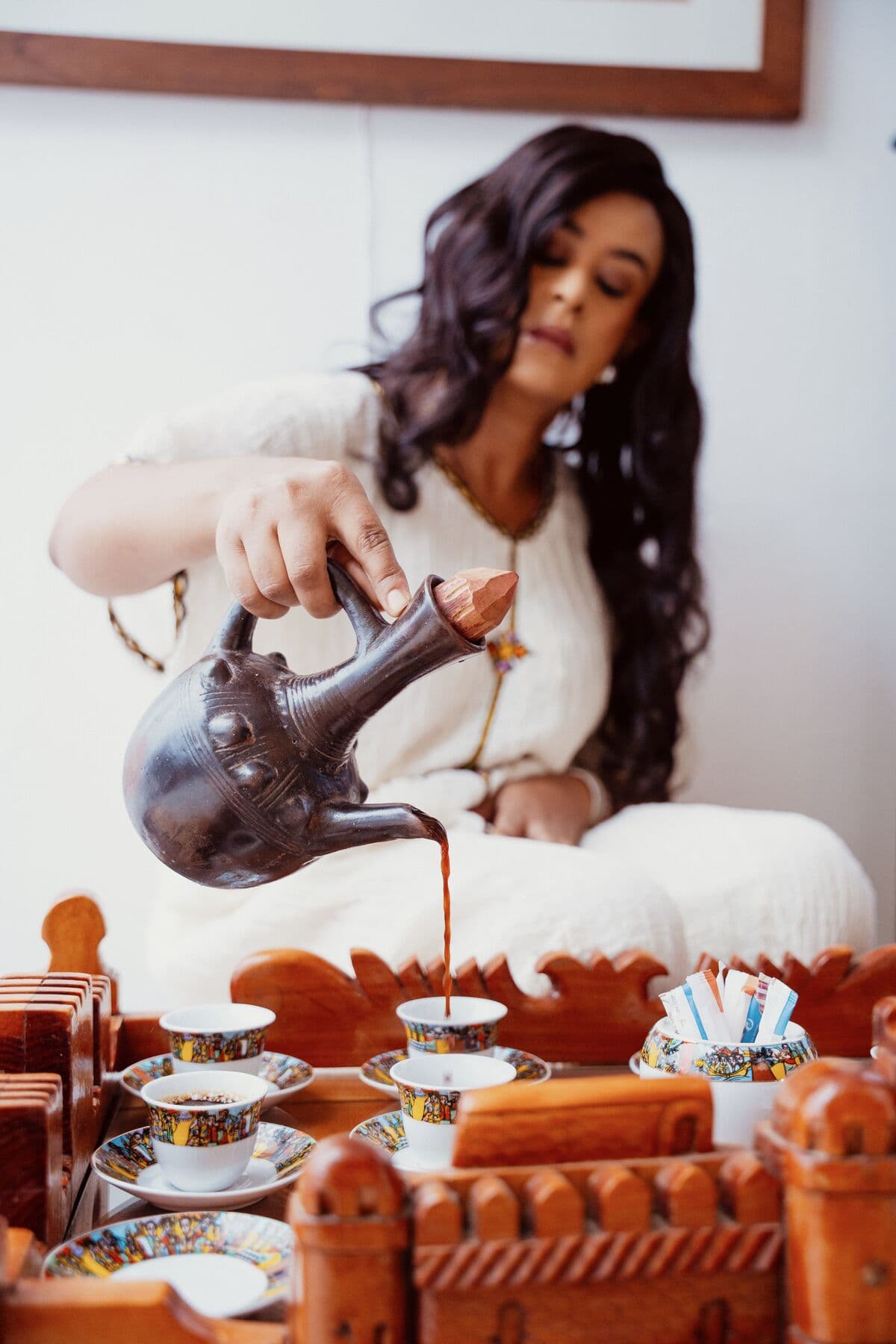
For anyone looking to get closer to the traditional Ethiopian method, the jebena remains the reference pot: a long-necked clay vessel, set over coals or a gentle flame, in which the ground coffee brews before being poured from a height into small cups. Our article on the jebena covers its shape, its use and the precautions to take, including which heat sources suit clay.
What about roasting, pan-roasted or bought ready-made?
The coffee sold at the concept store is already prepared for sale, not green beans meant to be roasted at home, so there is no need to repeat the roasting step yourself. For anyone curious about that step, performed in front of guests during the coffee ceremony at Ge'eza, our article on pan-roasting coffee the Ethiopian way explains the steps and a few general pointers for trying it, with no exact recipe attributed to the house.
A ratio to adjust by taste, not a fixed recipe
There is no single ratio of coffee to water that suits every method or every drinker, and Ge'eza does not publish one for the coffee it sells. A common starting point for many home brewers is a measuring spoon of ground coffee per cup of water, adjusted up for a stronger result or down for a lighter one, then refined over a few brews until the taste feels right. Keeping a rough note of what worked, the grind, the amount of coffee and the brewing time, makes it easier to repeat a good result the next time, rather than starting from scratch with each pot.
Brewing time, by method rather than by the clock
Brewing time varies with the method as much as the grind does. A moka pot is usually ready once the chamber fills and the sound of the steam changes, rather than at a fixed number of minutes. A French press is generally left to steep for a few minutes before the plunger is pressed down slowly, and a paper filter lets water pass through by gravity, at a pace set by the grind and the pour rather than a timer. A jebena, once on the heat, is watched rather than timed: it is removed once the coffee has properly infused, a judgment that comes with practice rather than a printed rule.
Taste it on site first
Before trying it at home, tasting Ge'eza's coffee on site remains the best way to get a feel for it. The full coffee ceremony, with its three rounds, Abol, Tona and Baraka, costs 7,000 F per person and lasts about 45 minutes, ideally booked 24 hours ahead, especially for a group. For a quicker moment, an Ethiopian macchiato at 4,000 F gives a taste of the house coffee without booking a set time.
Buying the coffee at the concept store
Ethiopian coffee is found in the fine grocery section of the concept store, in Point E, during the same hours as the restaurant. No price or specific variety is published online for this coffee: our article on buying Ethiopian coffee in Dakar explains where to find it on site and how to have it set aside over WhatsApp while the online shop is not yet open.
Before you leave with your coffee
For any question about a specific brewing method, or for advice on what suits the coffee you bought, message WhatsApp at +221 78 660 07 07. Ge'eza is open Tuesday to Sunday, 8am to 10pm, at 656 avenue Birago Diop, Point E.
Frequently asked questions
What grind should I use for a moka pot?
A fairly fine grind, close to what is used for espresso.
Should I use boiling water?
No, water just below a boil, left to settle briefly after boiling, generally gives a less bitter result.
How should I store coffee after buying it?
In an airtight container, away from light and heat, grinding only what you need each time.
Is the coffee at the concept store sold as green beans?
No, it is already prepared for sale, not meant to be roasted at home.
Can I taste Ge'eza's coffee before buying some?
Yes, with an Ethiopian macchiato at 4,000 F or during the full ceremony at 7,000 F per person.