
Guide · 27 October 2026
Pan-Roasting Coffee the Ethiopian Way
At Ge'eza, green coffee beans are washed and then pan-roasted in front of guests, before being pounded in a mortar. The steps of the gesture, and general pointers for trying it at home, with no invented claims.
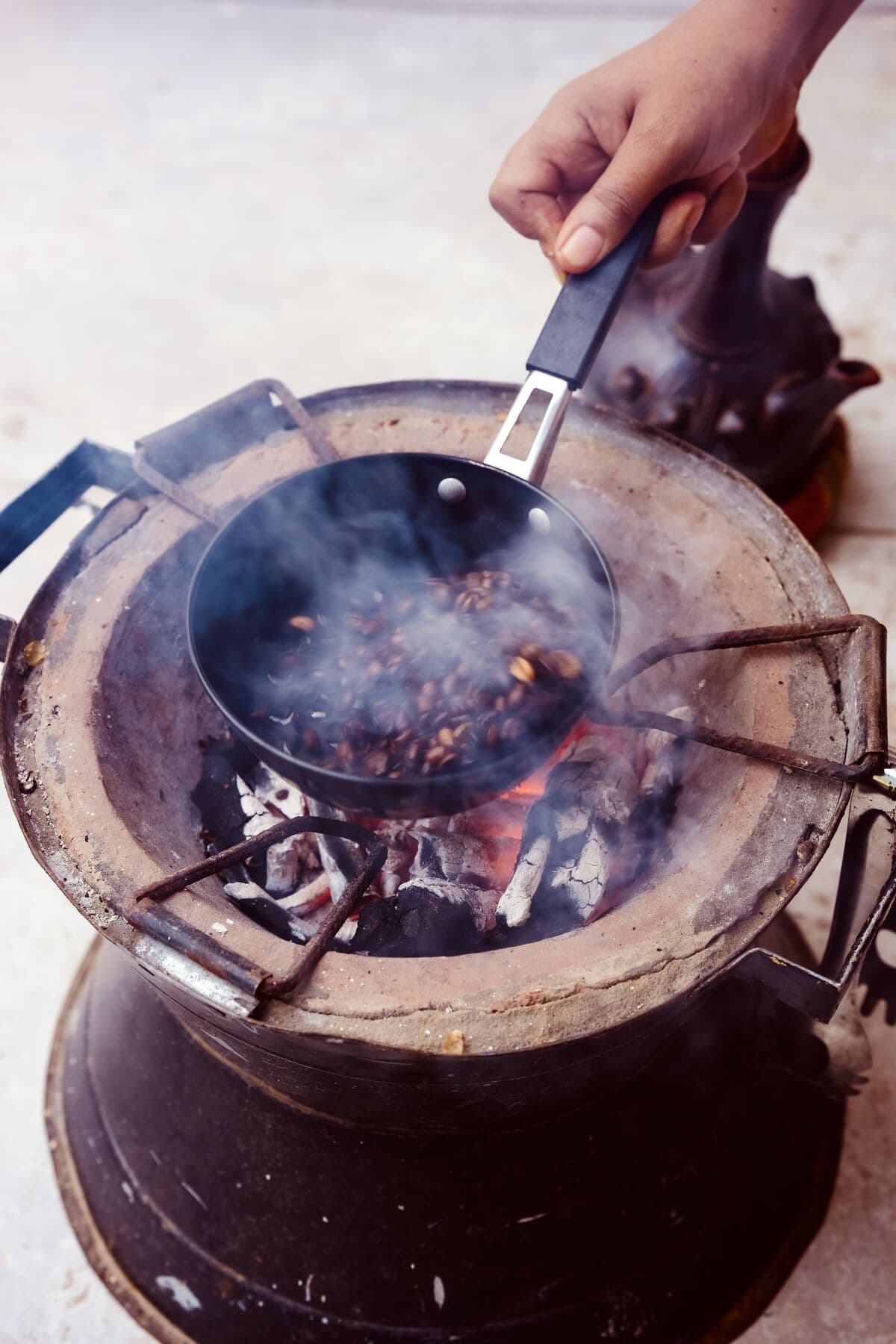
In the coffee ceremony at Ge'eza, in Point E, green beans are washed and then pan-roasted in front of guests, who are invited to breathe in the rising smoke. It is one of the most striking steps of the ritual, before the beans are hand-pounded in a mortar and brewed in the jebena.
The gesture, step by step
Roasting follows a precise order. The green coffee beans are first washed, to clear away dust and residue from their husks. They are then poured into a pan set over the embers, and stirred continuously so they do not scorch unevenly. Over the following minutes the beans change colour, from pale green to brown, and give off an increasingly dense smoke. That is the moment when guests are traditionally invited to lean toward the pan and breathe in the smoke, a gesture that marks the start of the ritual in a concrete way, just as the fresh grass and incense did earlier.
Why roast in front of guests
Roasting in front of guests is not a staged flourish: it is a way of sharing the coffee before it is even drunk, through its smell and sound. The crackle of beans in the pan, the rising smoke, the gradual shift in colour are as much a part of the ritual as the tasting itself. Coffee that arrives already roasted, prepared in a kitchen out of sight, would not tell the same story.
From roasted bean to cup
Once roasted, the beans are hand-pounded in a mortar, with no machine involved. The resulting grounds are then brewed in the jebena, the long-necked clay coffee pot, set over the embers. The coffee is finally poured from a height into small handleless cups, across three successive rounds, Abol, Tona and Baraka. The full sequence, from roasting to service, is laid out on the coffee ceremony page, where you can also book.
Trying it at home, a few general pointers
Pan-roasting coffee at home calls for simple equipment: a heavy-bottomed pan, a steady heat source and good ventilation, since the smoke is thick. The beans need constant stirring for even colouring, and are best judged by eye rather than by a timer, since the time it takes varies with the quantity of beans, the heat source and the origin of the coffee. It takes practice, and results will vary a good deal between early attempts. These are general pointers only: Ge'eza does not share a precise recipe or exact temperature for its own roasting.
Where the gesture comes from
This way of roasting coffee in front of guests, in a pan, has its roots in Ethiopian homes, where coffee, known as bunna, is a social ritual rather than a drink simply prepared ahead of time. The article origins of coffee in Ethiopia traces the history of coffee in the country, from the Kaffa region to the ceremony as it is known today.
Ethiopian coffee to take home
For anyone wanting to extend the experience after the ceremony, Ethiopian coffee is sold at the house's concept store, among the fine groceries alongside the spices. This is coffee already prepared for sale, not green beans meant to be roasted at home: the article buy Ethiopian coffee in Dakar explains where to find it and how to have it set aside by WhatsApp.
Seeing the gesture at Ge'eza
The full ceremony, with roasting performed in front of guests, the three rounds and homemade dabo, costs 7,000 F per person and takes about 45 minutes. It is best booked 24 hours ahead, especially for a group, through the coffee ceremony page or by WhatsApp at +221 78 660 07 07.
What the smell gives away
The smell of roasting shifts from start to finish: grassy and faint on the still-green beans, then rounder and toastier as the colour darkens. Guests who attend several ceremonies often learn to recognise that shift in smell before they even see the colour of the beans, a cue the Ge'eza team also uses to judge when to pull the pan off the embers.
A step no machine can take over
Unlike industrial roasting, carried out in large mechanical drums by the ton, pan-roasting stays a one-person gesture, suited to a small batch of beans and meant to be watched. That smaller scale is exactly what allows it to happen in front of guests: a closed machine could not recreate the same scene. It is also why no two ceremonies look quite the same, depending on the hand of whoever is roasting that day. For guests who return more than once, this small variation is often part of the appeal: the broad sequence of washing, roasting and grinding stays the same, while the exact pace and rhythm of the gesture shift slightly each time.
Frequently asked questions
Why is coffee roasted in front of guests?
To share its smell and sound before it is even drunk: that is as much part of the ritual as the tasting.
Can I pan-roast coffee at home?
Yes, with a heavy-bottomed pan, steady heat and good ventilation, stirring the beans constantly. These are general pointers, to be refined through practice.
Is the coffee sold at the concept store green beans?
No, the coffee on offer is already prepared for sale, not green beans meant to be roasted at home.
How long does the full ceremony take with the roasting included?
About 45 minutes, for 7,000 F per person, with all three rounds included.