Food · 28 September 2026
Beyaynetu: The Ethiopian Platter of Seven Fasting Dishes
Beyaynetu brings seven vegan fasting dishes together on one large injera, for 1, 2 or 3 people. What is in it, how to order and eat it, and the meat version, at ge'eza in Dakar.
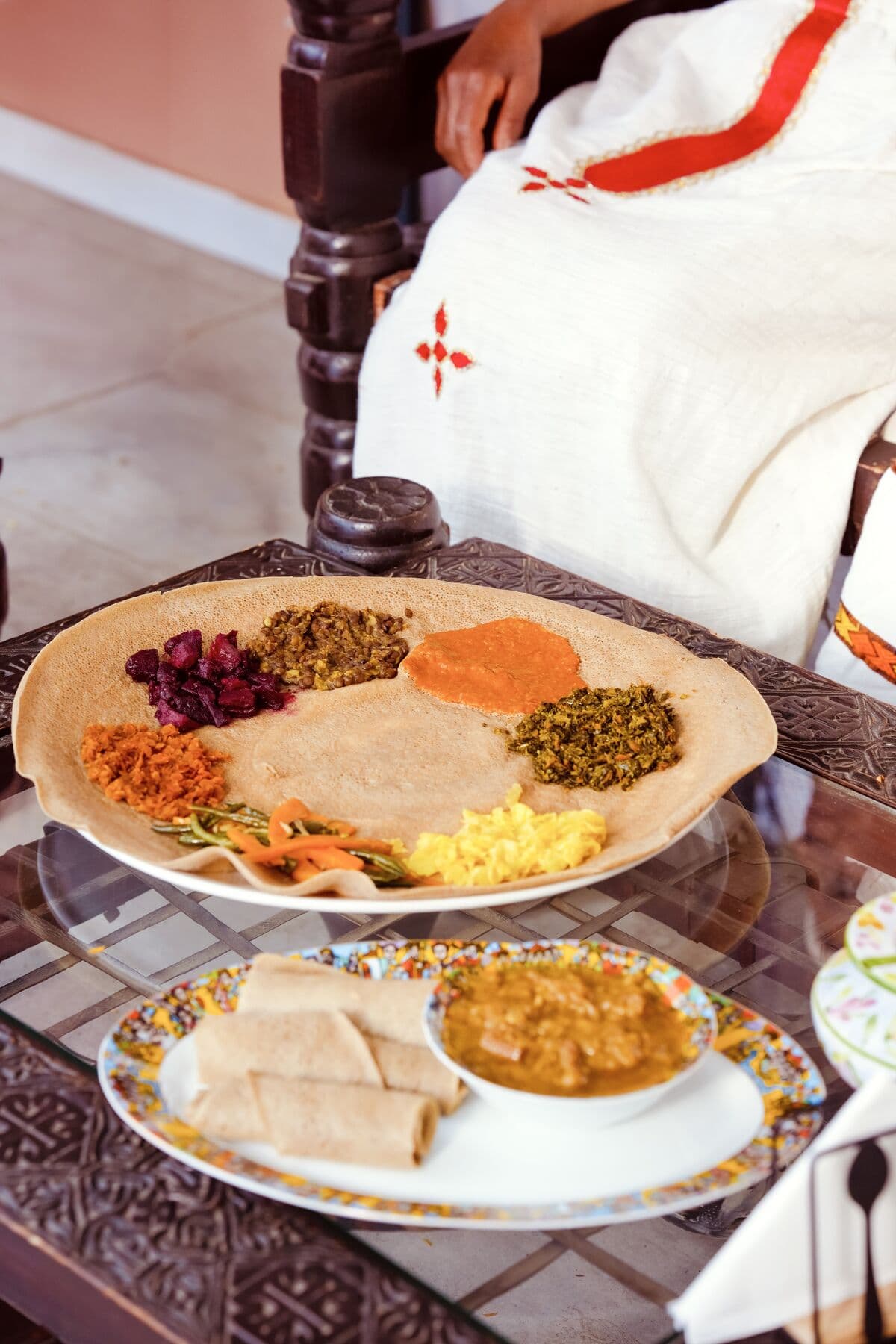
Beyaynetu is the Ethiopian platter that gathers several fasting dishes on one large injera. At ge'eza it holds seven vegan dishes: Shiro, Misir, Fosolia, Gomen, Key Sir, Tikil Gomen and Alicha Ater Kik. It comes for 1, 2 or 3 people, from 7,000 F for one, and it is the best doorway into Ethiopian food.
What beyaynetu means
The word, in Amharic, evokes something like "of several kinds". That is exactly the idea: instead of choosing one dish, you get a varied sample of fasting cuisine. Each dish has its place on the large injera, in small mounds of different colours: the red of the Shiro, the yellow of the split peas, the green of the Gomen, the deep purple of the beetroot.
Fasting dishes are prepared without meat, dairy or eggs, in line with the Ethiopian Orthodox fast described in Ethiopian fasting dishes. At ge'eza they are all vegan, made from pulses and selected spices, without butter.
The seven dishes, one by one
- Shiro Wot: finely ground chickpeas simmered in a deep, fragrant berbere sauce. Thick and comforting.
- Misir Wot: red lentils simmered with turmeric, garlic and spices. Soft and melting.
- Fosolia: green beans and carrots sautéed with Ethiopian spices. A note of freshness.
- Gomen: collard greens sautéed with garlic and onion, sourced fresh from Growing Life Farm, a women-led farm in Dakar.
- Key Sir: Ethiopian beetroot, slow-cooked, earthy and naturally sweet.
- Tikil Gomen: cabbage cooked with turmeric, garlic and olive oil. Mild and delicate.
- Alicha Ater Kik: split peas gently cooked with turmeric. Golden and melting.
The contrast is deliberate: spiced sauces, mild vegetables, thick textures and lighter ones. By taking a little of each dish you build your own pairings, a bite of Shiro with Gomen, or beetroot with lentils.
For 1, 2 or 3 people
Beyaynetu is ordered in three sizes, made for sharing. The entry price is 7,000 F for one person. For two or three people the platter is larger and the portions are adjusted accordingly. For a bigger group you can order several platters.
It suits a mixed meal well: vegetarians and vegans find a complete meal, and others can add a meat dish. It is also recommended on a first visit, because you discover the diversity of the menu in one go.
What if I want meat?
Ye Fisig Beyaynetu is the meat version: three fasting stews and one meat stew of your choice, gathered on the same injera. The menu describes it as the bridge between fast and feast. It is 7,000 F for one person, 10,000 F for two and 16,000 F for three. Doro wot, Siga Wot or Tibs can also be added next to a classic beyaynetu (see doro wot).
How to eat it
Everything is eaten with your right hand and injera. Tear a piece, pick up some of a dish, fold, bring it to your mouth. In a group, you take from your own side of the platter, without reaching across. The injera at the bottom, soaked in sauces, is eaten at the end, and is often the best moment. The gursha gesture, the offered mouthful, is happily practised around this dish: gursha, eating with your hands. To understand injera itself: injera explained.
When to order it
Beyaynetu is on the restaurant menu, at lunch as at dinner. It works as well for a first Ethiopian meal as for a group meal. As the fasting dishes are vegan, it is a simple choice for tables where several diets meet. In case of allergy or a special diet, tell the team when ordering.
Coming to ge'eza
The house is open Tuesday to Sunday, 8am to 10pm, at 656 avenue Birago Diop, Point E. To be sure of a table in the evening or at the weekend, book online. The full menu is on the restaurant page.
A dish that fits the moment
Beyaynetu suits several uses. For a working lunch, it is chosen for its ease: one tray, bites to share, simple service. For a dinner as a couple or among friends, it becomes a game of discovery: who prefers the sweetness of beetroot, who takes the Shiro? And for a family with children, it lets them taste mild dishes, such as Tikil Gomen, without ordering separately.
What to add
Beyaynetu is a full meal on its own. If you want to extend it, add a meat dish for the table to share, such as tibs (8,000 F) or doro wot (8,000 F), and finish with coffee: a macchiato at 2,500 F, or the full ceremony at 5,000 F. Sambusa, lentil (1,500 F, vegan) or meat (2,000 F), make a good starter, and homemade peanut baklava, 5,000 F, a sweet close.
Reading the platter
When the beyaynetu arrives, look at how the dishes are arranged: colours are separated on purpose, and the milder ones often sit beside the hotter ones. Start with a mild dish to set your palate, move to the Shiro, and finish with the beetroot. There is no rule, but this order makes the flavours easy to follow.
Frequently asked questions
Is beyaynetu vegan?
Yes. The seven dishes are vegan, prepared without butter. Ye Fisig Beyaynetu, however, contains a meat stew.
How many people does one platter feed?
It is ordered for 1, 2 or 3 people, from 7,000 F for one person.
Is beyaynetu very spicy?
It alternates bold dishes, like the Shiro, with mild ones, like Tikil Gomen or Alicha Ater Kik. Each guest doses to taste.
Is it gluten-free?
The menu presents the injera as naturally gluten-free. Tell the team in case of allergy.