
Food · 6 October 2026
Ethiopian Macchiato: Addis Ababa's Italian Legacy, 2,500 F
The Ethiopian macchiato is an intense espresso softened with a little hot milk, a legacy of the Italian presence that became an Addis Ababa habit. How it is drunk, and where to try it in Dakar at Ge'eza, for 2,500 F.

The Ethiopian macchiato is an intense espresso softened with just enough hot milk. In the cafés of Addis Ababa it is often called "makiyato" and ordered at any hour of the day. At Ge'eza, 656 avenue Birago Diop in Point E, it is served for 2,500 F, and the menu places it somewhere between a macchiato and a piccolo latte.
An Italian drink in a coffee homeland
Ethiopia is where coffee began, and its coffee culture is far older than espresso. The ceremony, the clay jebena, the three rounds of cups: all of it existed long before the first pressure machine arrived in the country. Espresso is an Italian contribution. Between 1936 and 1941 Italy occupied Ethiopia, and the period left lasting marks on the cities, above all Addis Ababa: cafés with counters, espresso machines, pasta and pizzerias that are still part of the scenery.
The Addis macchiato is one of the most visible of those legacies. The Italian word means "marked" or "stained": originally, an espresso stained with a little milk. In Ethiopia the drink took on a life of its own. It became the ordinary order for the morning, the afternoon break, the meeting with a friend, served in a small glass or a ceramic cup, often with a little more milk than an Italian macchiato would have. That is the version Ge'eza serves.
What is in the cup
The house menu describes it as an intense Ethiopian espresso, softened with a little hot milk. So two things meet in the cup.
- An Ethiopian coffee, whose notes vary with the region and the roast. For an overview, see Ethiopian coffee regions: Yirgacheffe, Sidamo, Harrar, Guji.
- A touch of hot milk, which rounds the bitterness without erasing the coffee. It is not a big milky coffee: the cup stays short and concentrated, with a texture a little rounder than a plain espresso.
It suits people who find straight espresso too dry and a milky coffee too soft. It also suits travellers who want a taste of Ethiopia without setting aside an hour.
Macchiato or ceremony: two different kinds of time
The macchiato and the coffee ceremony answer different wishes.
The macchiato is a counter drink: quick, individual, urban. You have it in ten minutes, before a meeting, after lunch, while working. It belongs to the city Ethiopia of the twentieth century.
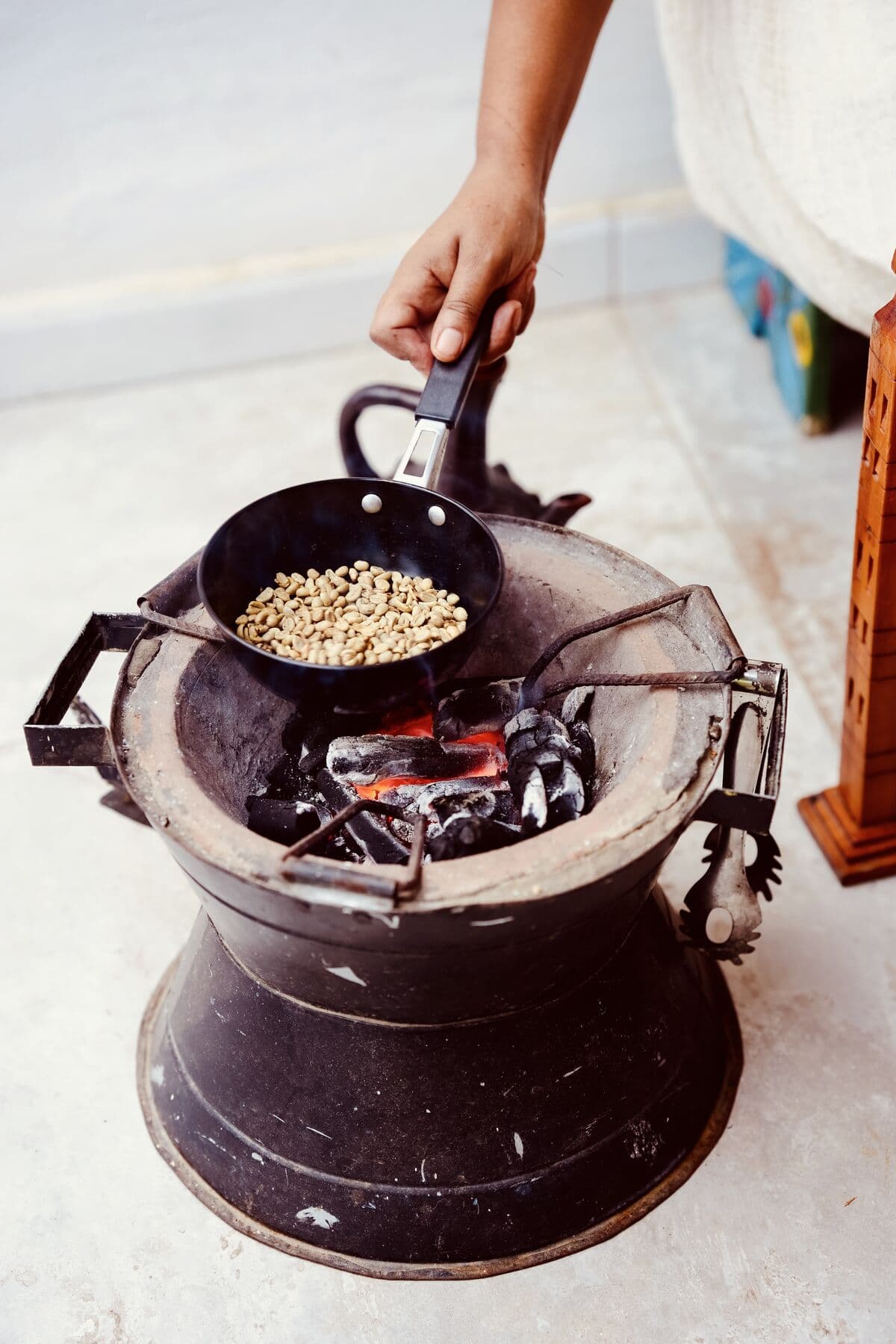
The ceremony is a ritual of hospitality. The coffee is roasted fresh, ground by hand and brewed in a clay jebena, then served in three rounds, Abol, Tona and Baraka. It takes about 45 minutes and costs 5,000 F per person. You do not take it to wake up but to spend time together. The detail is in the Ethiopian coffee ceremony as a language of hospitality.
Many visitors do both in a single visit: a macchiato on arrival, the ceremony to close a long lunch.
How to drink it
There is no fixed ritual, but a few habits help.
- Taste it as it comes first. The first sip shows the balance between the bitterness of the coffee and the roundness of the milk.
- Drink it hot, without hurry. The cup is small and cools fast.
- Leave sugar for later. Many Ethiopians sweeten their coffee, which is entirely normal. If you like that, ask for it, but try it plain first.
- Pair it with a bite. House dabo, served with honey, at 1,000 F, or a lentil sambusa, at 1,500 F, go well with a short, strong drink.
A macchiato for every part of the day
The house opens at 8am, and the Ethiopian breakfast is served from 8am to 11am. A macchiato with a chechebsa at 4,500 F or a foul at 5,500 F makes a very Ethiopian start to the day. At midday it follows naturally after the Senegalese dish of the day, served Tuesday to Friday. In the afternoon it keeps company with work: the café also welcomes people who come with a laptop, with Wi-Fi available.
In the evening espresso is less common, but nothing stops you from ending a dinner with a macchiato instead of a full ceremony when time is short.
And if you prefer it cold?
The menu also offers iced coffees, from an iced Ethiopian coffee at 2,500 F to an iced spiced latte at 3,500 F. They have their own article: iced Ethiopian coffee. They suit hot days better than the macchiato, which is a hot drink by definition.
Why this history matters in Dakar
At Ge'eza the Ethiopian macchiato illustrates the idea that guides the house: a bridge between two Africas, and more widely between histories that cross. An Italian drink, adopted by Ethiopia, served in Senegal: the journey of one cup already says a lot.
It also carries an important nuance. The Italian legacy in Ethiopian food and coffee says far from everything about Ethiopian culture, and it comes from a period of occupation that the country lived as an ordeal. The macchiato became Ethiopian because Ethiopians made it their own, with their coffee, their way of receiving guests and their own hours.
Coming to try it
Ge'eza is open Tuesday to Sunday, 8am to 10pm, and closed on Monday. For a table at lunch or at the weekend you can book online or write on WhatsApp at +221 78 660 07 07. For a simple coffee there is no need to book, but for a group it is better to let the team know.
Frequently asked questions
How much is the Ethiopian macchiato at Ge'eza?
It is 2,500 F. That is the same price as the iced Ethiopian coffee, and less than the full ceremony, at 5,000 F per person.
How is it different from an Italian macchiato?
The Ethiopian macchiato is generally a little milkier. The Ge'eza menu describes it as an intense espresso softened with hot milk, between a macchiato and a piccolo latte.
Is the macchiato traditional in Ethiopia?
The drink is common in Ethiopian cafés, especially in cities. It comes from the Italian influence of the twentieth century, while the coffee ceremony, with the jebena, is far older.
Can I have it at breakfast?
Yes. The house opens at 8am, and the Ethiopian breakfast is served from 8am to 11am.