
Food · 6 October 2026
Ethiopian Lamb Dishes: Lamb Wot and Kikil in Dakar
Lamb in Ethiopian cooking: lamb wot, simmered with turmeric, and kikil, a lamb broth, both 9,000 F at Ge'eza. How they differ from beef siga wot, the sauces, and how to taste them.
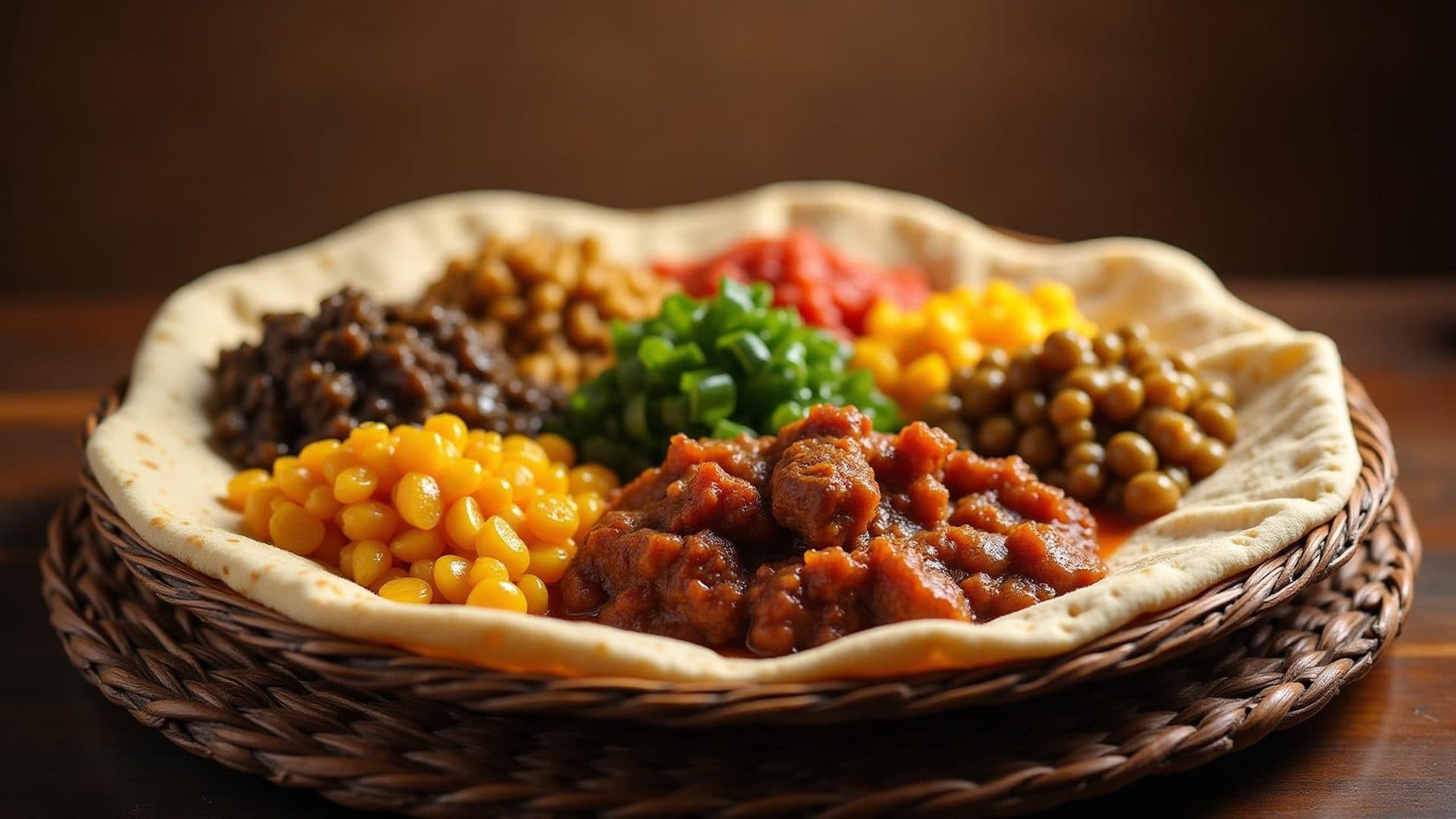
In Ethiopian cooking, lamb is mostly prepared as a stew. At Ge'eza the menu offers two lamb dishes: the lamb wot (mouton wot), lamb slowly simmered in an Ethiopian turmeric sauce, at 9,000 F, and the kikil, a lamb broth with turmeric and kibbeh, also at 9,000 F. They are two ways of tasting lamb, one in sauce, one in broth. The restaurant is at 656 avenue Birago Diop in Point E, Dakar, open Tuesday to Sunday, 8am to 10pm.
Lamb wot: lamb in turmeric sauce
The word wot means a sauced stew, and beg, in Amharic, means sheep. Lamb wot is therefore the lamb stew. The menu describes it as lamb slowly simmered in a turmeric Ethiopian sauce, rich, warm and deeply fragrant.
What stands out is the colour: a golden yellow from the turmeric, far from the deep red of berbere wots. This is the alicha style of sauce, meaning mild, without the heat of the red sauces. The dish is tender, scented with garlic and spices, with a thick sauce that soaks into the injera. It is served at 9,000 F on injera, like the house's other meat dishes.
Lamb wot, siga wot and alicha siga wot
The meat wots are often confused. Ge'eza's menu has several, and the difference comes down to the meat and the sauce.
- Lamb Wot, 9,000 F: lamb, turmeric sauce.
- Siga Wot, 8,000 F: beef slowly simmered in an intense berbere sauce. Deep, spicy and complex, says the menu.
- Alicha Siga Wot, 9,000 F: beef gently simmered with turmeric, golden and tender, with all the depth without the intensity of berbere.
- Doro Wot, 8,000 F: chicken simmered in clarified butter, served with a hard-boiled egg. See doro wot.
Lamb wot therefore resembles alicha siga wot in its sauce, but differs in the meat. Siga wot, by contrast, changes register thanks to the berbere, and is closer to a bold, spiced dish. If you want gentleness, choose lamb wot or alicha siga wot; if you want chilli, siga wot.
Kikil: the lamb broth
Kikil is a dish apart. The menu presents it in one sentence: lamb broth with turmeric and kibbeh, 9,000 F. Where wot is a thick stew, kikil is more liquid, closer to a broth in which the meat cooks, with the turmeric and the herb-infused clarified butter perfuming the liquid.
It is a dish with character, eaten with injera to soak up the broth, or with a spoon depending on its consistency. If you are used to simple, readable dishes, it is a fine way to taste lamb without a thick sauce.
The kibbeh that ties it together
The menu states that all the house's meat is bought fresh in Dakar and prepared following traditional Ethiopian recipes with kibbeh, the herb-infused clarified butter. It is this butter, infused with herbs and spices, that gives these dishes their roundness and fragrance. Kikil mentions it explicitly. To understand the base spices, read berbere, mitmita and niter kibbeh.
How to eat them
Like any Ethiopian dish, by hand, with injera. Tear off a piece, pick up meat and a little sauce, fold, eat. For a meat dish like lamb wot, the injera at the bottom, which has absorbed the sauce, is the best part: keep it for the end.
In a group, sharing comes naturally: a lamb wot, a siga wot and a beyaynetu for guests who do not eat meat make a complete meal. Beyaynetu is from 7,000 F for one person, and the Ye Fisig Beyaynetu combines three fasting stews and one meat stew of your choice, at 7,000 F for 1, 10,000 F for 2 and 16,000 F for 3.
Which drinks
A lamb dish in a rich sauce calls for a clear drink. A ginger juice at 1,500 F, a bissap at 1,500 F, or for an occasion a tej at 3,500 F, the Ethiopian honey wine. Birz, at 2,000 F, is its alcohol-free counterpart. To close the meal, the Ethiopian macchiato at 2,500 F, or the full coffee ceremony at 5,000 F per person.
One clarification
For any question about where the meat comes from or how it is prepared, the team will answer before you order.
Coming to Ge'eza
To see the full menu, visit the restaurant page. For a table in the evening or at the weekend, book online or write on WhatsApp at +221 78 660 07 07.
Building a meal around lamb
For a lunch or dinner centred on lamb, here are a few ways to compose the table, with the menu prices.
- For two: a lamb wot at 9,000 F and a fasting dish at 5,500 F, such as misir wot, make 14,500 F of dishes to share. The contrast between meat in turmeric sauce and mild lentils is very pleasant.
- With a broth: a kikil at 9,000 F and a gomen at 5,000 F for the freshness of the greens, which makes 14,000 F.
- For the curious: a lamb wot and a siga wot, 17,000 F in all, to compare lamb with turmeric and beef with berbere on the same platter.
In each case, add sambusas as a starter, 2,000 F for the portion with meat or 1,500 F with lentils, and finish with coffee. The full ceremony is 5,000 F per person and lasts about 45 minutes.
Lamb in the Ethiopian tradition
Lamb appears in Ethiopian cooking in several forms, from stews to broths. At Ge'eza it comes in two dishes, a stew and a broth, both prepared with the house's kibbeh. If you wish to know more about the seasoning on a given day, the team will tell you.
Frequently asked questions
What is the difference between lamb wot and siga wot?
Lamb wot is lamb simmered in a mild turmeric sauce. Siga wot is beef in an intense berbere sauce, spicier.
What is kikil?
A lamb broth with turmeric and kibbeh, 9,000 F.
How much do the lamb dishes cost?
Lamb wot is 9,000 F and kikil is 9,000 F.
Is lamb wot spicy?
Its sauce is turmeric-based, milder than berbere. It is more fragrant than hot.