Dakar · 28 September 2026
Ethiopia and Senegal: The Historic Ties Between Two Countries
Senghor and Haile Selassie, the founding of the OAU in Addis Ababa in 1963, the 1966 World Festival of Black Arts in Dakar: what connects Ethiopia and Senegal, without shortcuts.
Ethiopia and Senegal share a history that is more pan-African than bilateral: Ethiopia, a symbol of African independence, hosted the founding of the Organisation of African Unity in Addis Ababa in 1963, in which Senegal took part; and Dakar staged the World Festival of Black Arts in 1966, a landmark celebration of African cultures. Two countries far apart on the map, close in ideas.
Ethiopia, a symbol for the independence movements
In the imagination of many twentieth-century African movements, Ethiopia holds a special place. It is one of the few countries on the continent that escaped lasting colonisation, despite the Italian occupation from 1936 to 1941. In the era of independence, that history gave Addis Ababa strong symbolic weight, which Emperor Haile Selassie embodied on the international stage.
Senghor's Senegal
Senegal became independent in 1960 with Léopold Sédar Senghor as its first president. A poet and a thinker of négritude, Senghor made culture a pillar of national policy. His idea was that Africa should present itself to the world through its arts and ideas, not only its resources.
These two paths, an old empire that kept its independence and a young republic driven by culture, meet in the wider movement of pan-Africanism.
1963: Addis Ababa and the OAU
In May 1963, some thirty independent African states met in Addis Ababa to found the Organisation of African Unity. Senegal was among the countries present. Addis Ababa became the place where cooperation between African states was worked out, and it is now home to the African Union, the successor to the OAU. We come back to this in our article on Addis Ababa and Dakar, two capitals.
1966: Dakar and the World Festival of Black Arts
Three years later, Dakar hosted the World Festival of Black Arts with UNESCO's support. For several weeks, artists, writers and musicians from Africa and its diaspora gathered in the Senegalese capital. The festival left a lasting mark on the city's cultural life, covered in our article on the 1966 festival. We do not detail here the exact participation of each country, so as not to state anything inaccurate.
What remains today
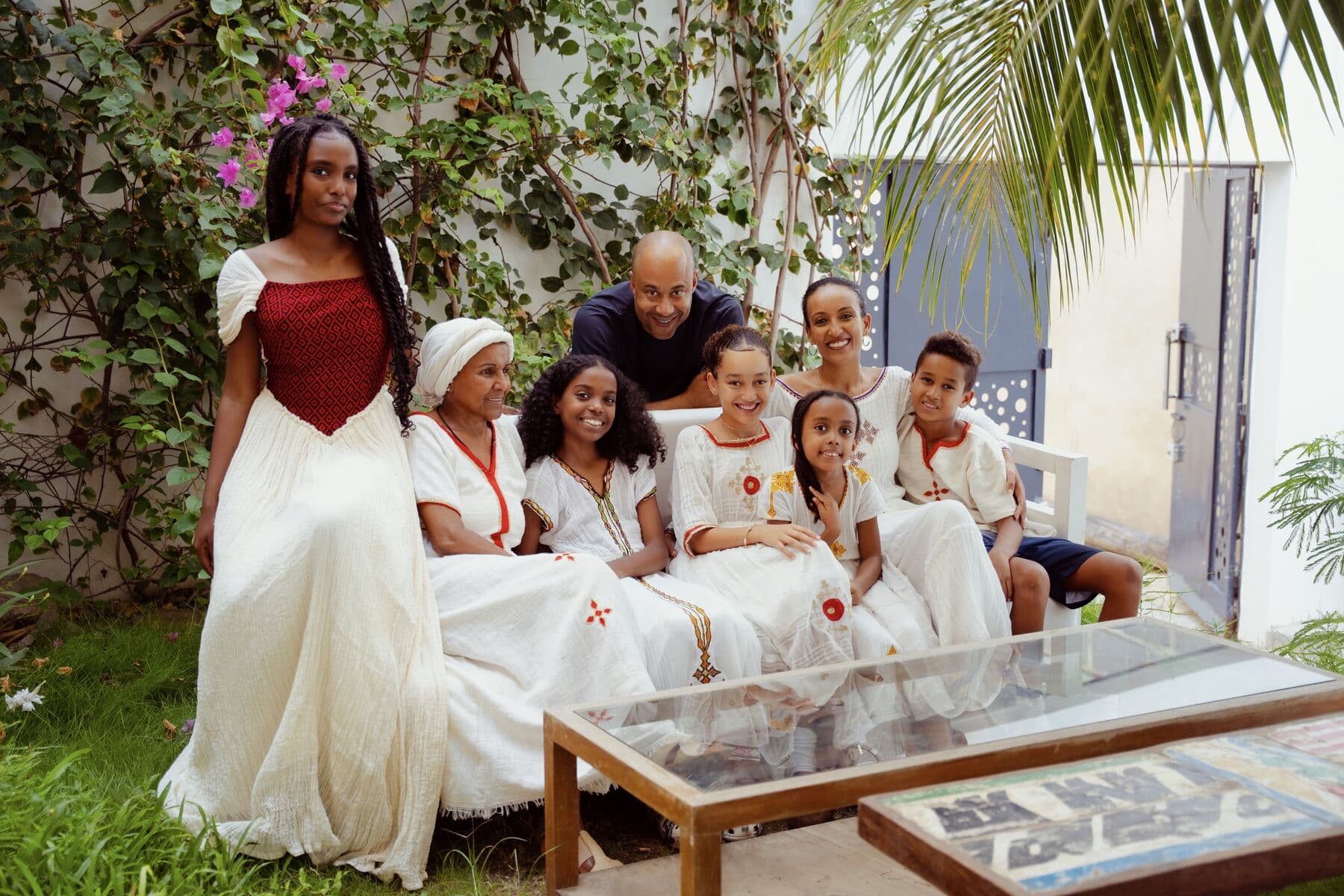
The ties between the two countries are not limited to those two dates. Today they show up in quieter encounters: diplomats, students, entrepreneurs, artists, Ethiopian families settled in Dakar. This blend can be read at the table, in galleries, at celebrations. Our article on the Ethiopian community in Dakar gives a glimpse.
Where the thread continues in Dakar
This is the context in which ge'eza sits. The house, at 656 avenue Birago Diop in Point E, is an Ethiopian restaurant, a gallery and an events venue founded by Maraki Germa Bekele, who is Ethiopian. It serves foul at breakfast, injera, vegan fasting dishes, doro wot, and from Tuesday to Friday a Senegalese dish of the day: mafé on Tuesday, thiéboudienne on Wednesday, supou kanja on Thursday, chicken yassa on Friday. The gallery shows artists from East and West Africa.
In other words, what history built at the level of states, the house offers at the level of a table: two culinary traditions and two art scenes under one roof. To experience the dialogue, you can book a table or drop by the gallery.
Going further
If the subject interests you, three general reading leads: Senghor's writings on négritude, the history of the founding of the OAU, and the catalogues of the 1966 festival. They let you check and deepen what is summarised here.
Two visions of culture as a force
For Senghor, culture comes before politics: it gives peoples the confidence they need to negotiate as equals. On the Ethiopian side, the antiquity of the state, of the Orthodox Church, of the Geez script and of the calendar has fed a very strong sense of identity. The two outlooks are not identical, but they arrive at the same conviction: Africa has contributions of its own to present to the world.
What these ties teach anyone organising a meeting
When you bring Ethiopian and Senegalese counterparts together today, it helps to know this background. A word about the founding of the OAU or the 1966 festival shows that you are not there only for a file. It opens the conversation, and common subjects appear quickly: food, coffee, music, the visual arts.
Reading and listening to go further
Besides Senghor's texts, you can read historians' work on pan-Africanism and Ethiopian history, listen to radio archives from the period, or visit Dakar's museums devoted to African civilisations. These sources let you check every point in this article and add nuance to it.
A note on sources
Dates and names in this article are the widely established ones: independence in 1960, the OAU in 1963, the festival in 1966. Where details are debated or hard to verify, we have chosen to stay general rather than risk an error. If you plan to quote this history in a speech or a publication, check it against a primary source and cite that source.
Frequently asked questions
Do Ethiopia and Senegal have direct historic ties?
Mostly a shared pan-African history: the founding of the OAU in Addis Ababa in 1963 and Dakar's World Festival of Black Arts in 1966 are the main common landmarks.
Why does Ethiopia hold a symbolic place in African history?
Because it preserved its independence during the colonial period, apart from the Italian occupation from 1936 to 1941, which made it a reference for independence movements.
Where is the African Union headquartered?
In Addis Ababa, where the Organisation of African Unity had already been founded in 1963.
Can I try Ethiopian food in Dakar?
Yes, at ge'eza, Tuesday to Sunday from 8am to 10pm. Ethiopian breakfast is served from 8am to 11am.