
Art · 22 October 2026
Senegal's Markets in Painting, From Louga to Sandaga
Titles such as 'Marché de Louga', 'Marché hebdomadaire', 'Jour de marché' and 'Marché aux poissons' by Ibou Diagne; 'Marché Sandaga', Colobane and Thiaroye by Tampidaro: the Senegalese market as a recurring subject at Ge'eza's gallery.
The market is a subject that returns often in contemporary Senegalese painting, and Ge'eza's gallery shows several examples of it. From Ibou Diagne: "Marché de Louga," "Marché hebdomadaire," "Jour de marché" and "Marché aux poissons" (market scene paintings). From Tampidaro: "Marché Sandaga," "Le marché de Colobane" and "Le marché de Thiaroye." All of these paintings are currently available, with the price given on request from their page.
The louma, a Senegalese institution
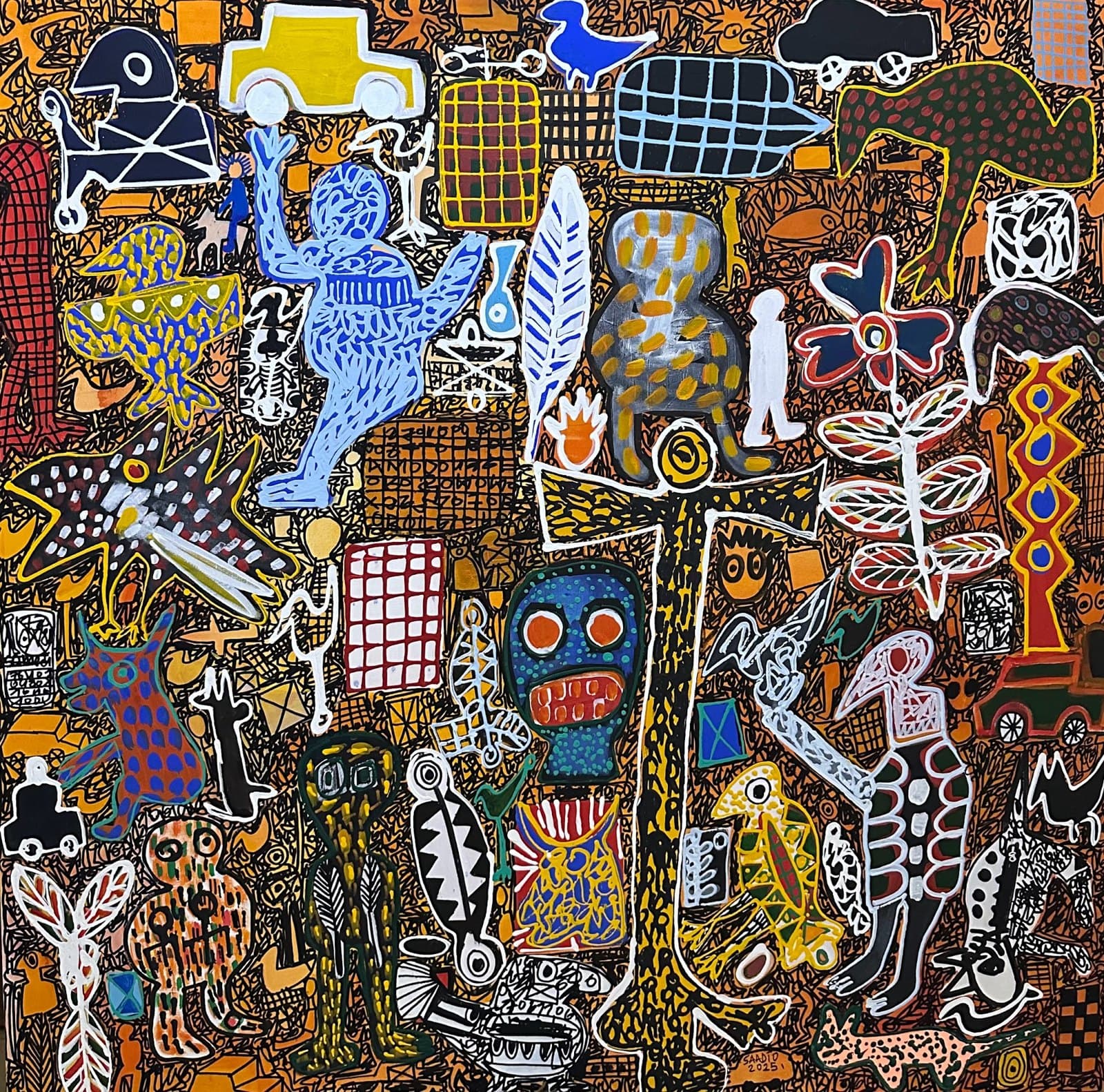
Before looking at these paintings, a word on what their titles name. In Senegal, a louma is a large periodic market, usually weekly, that gathers sellers, some travelling a long way, around a town or a road junction for a single day. Depending on the region and the season, it can carry food crops, livestock, textiles or hardware. That weekly rhythm, which still shapes part of rural and peri-urban trade, is exactly what the title "Marché hebdomadaire" (weekly market) names, a title used by both Ibou Diagne and, on a different canvas, Saadio: two different artists chose the same words for two separate works, a useful reminder that a title alone never identifies a specific painting without naming the artist too.
Alongside the periodic louma, Dakar's permanent urban markets, such as Sandaga or Colobane, run daily and hold a different place in the life of the city: dense, busy places of retail trade, known to every resident of Dakar.
Ibou Diagne: four titles, one subject returning
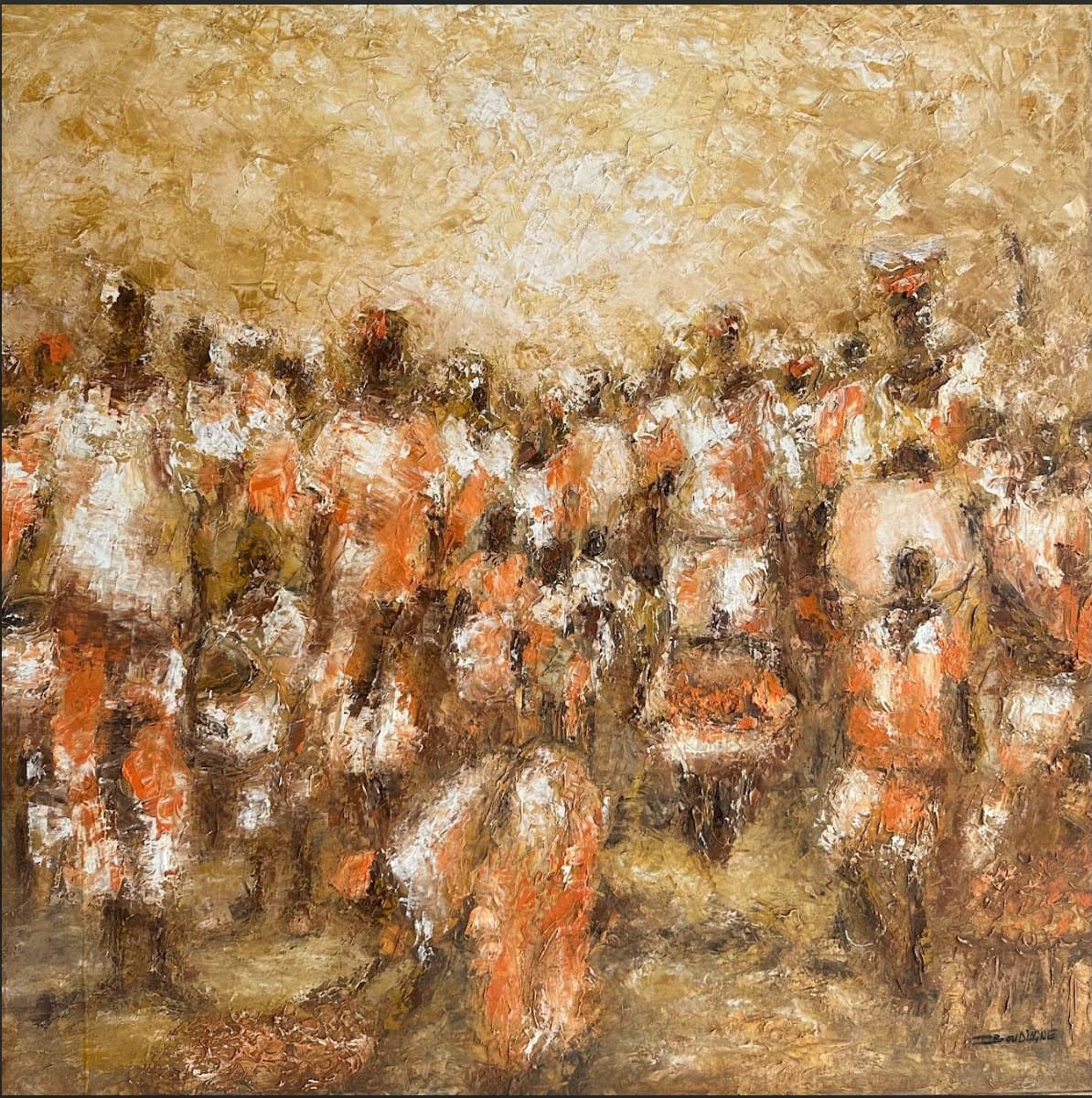
"Marché de Louga," an oil painting on canvas at 100 x 100 cm made in 2023, names a town in northern Senegal known for its market, the subject of the work, not the artist's place of origin. "Marché hebdomadaire," an oil on canvas at 100 x 100 cm, also from 2023, carries the very rhythm of the louma in its title. "Jour de marché" (market day), an acrylic on canvas at 70 x 90 cm made in 2025, changes technique and format for the same subject. "Marché aux poissons" (fish market), an oil on canvas at 180 x 120 cm from 2025, is the largest format in the series; its title points to the fish market. The page for "Marché de Louga" gives the full technique, size and status of that painting.
That the same subject returns under several titles and techniques says something about Ibou Diagne's work: the market is not named once and settled, but found again across several titles, with an oil painting here, an acrylic there, a square or a large rectangle depending on the piece.
Tampidaro: markets as landmarks of urban Dakar
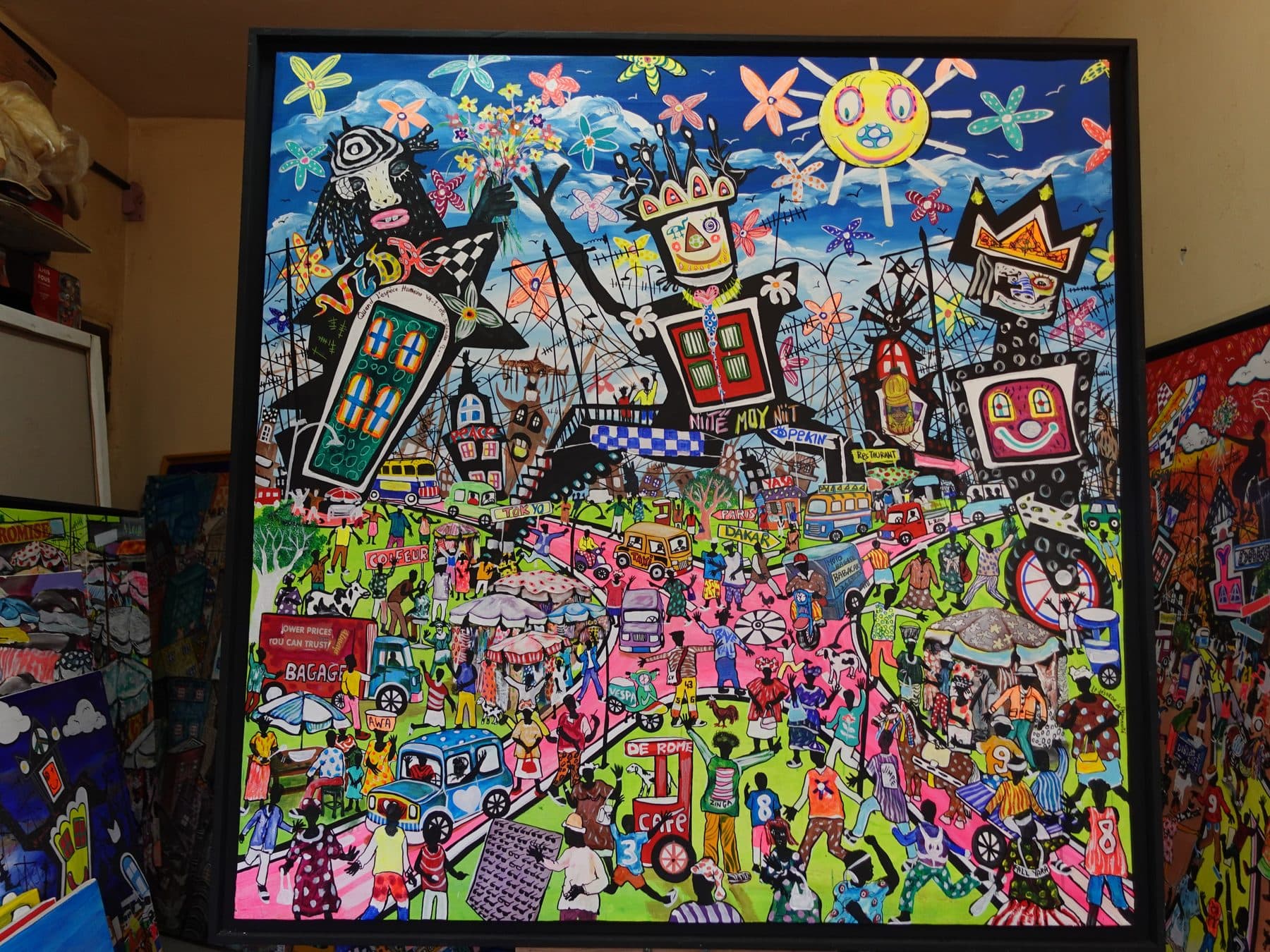
Tampidaro, for his part, paints markets named after their place in Dakar. "Marché Sandaga," a mixed acrylic work at 100 x 120 cm made in 2025, carries the name of the best-known market in downtown Dakar. "Le marché de Colobane," a mixed acrylic work at 100 x 100 cm, also from 2025, names another well-known market in the capital. "Le marché de Thiaroye," a mixed acrylic work at 70 x 50 cm from 2025, rounds out the series with a tighter format. The page for "Marché Sandaga" gives the details for that painting. All three titles, like much of Tampidaro's current body of work, point to urban Dakar.
Oil and acrylic, two materials for one subject
The paintings gathered here fall into the two main techniques found at the gallery. Oil, which Ibou Diagne chose for some of his market scenes, dries slowly and allows long work on a surface. Acrylic, which he also uses for other works in the same series, dries faster and often gives flatter, crisper fields of colour. Tampidaro's mixed acrylic, consistent across his current body of work, follows yet another logic, with several layers and gestures built up over one another. Neither technique is better than the other: they simply produce different surface effects, visible once you are in front of the actual canvas.
Hanging a market scene
A painting of this kind often benefits from a hang with room to breathe: a clear wall, enough distance, and light that does not flatten the ridges of paint. For the largest formats, such as "Marché aux poissons" at 180 x 120 cm, it is worth measuring the wall ahead of time and leaving a margin on each side.
Seeing these paintings and asking for a price
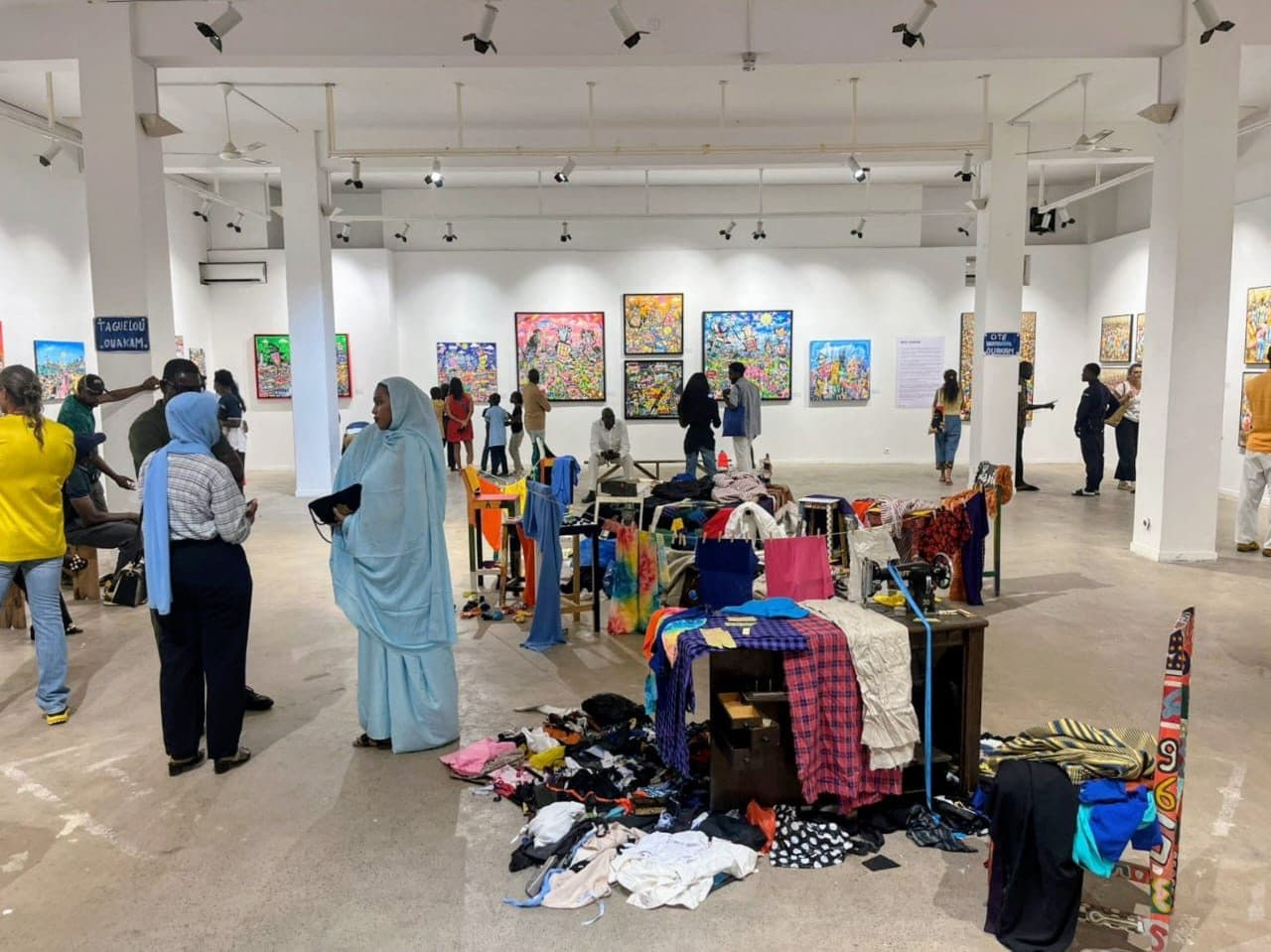
All of these works can be seen at Ge'eza's gallery in Point E, during the restaurant's hours, Tuesday to Sunday, 8am to 10pm. The price of each is given on request from its page, or directly on WhatsApp at +221 78 660 07 07, naming the exact title and the artist to avoid any mix-up between two works sharing the same name.
Frequently asked questions
Why do two artists each have a painting called "Marché hebdomadaire"?
Ibou Diagne and Saadio each made a work under that title; they are two separate paintings, which is why it matters to name the artist along with the title.
What is a louma?
A large periodic market, usually weekly, that gathers sellers around a town or a road junction in Senegal.
Which Dakar markets did Tampidaro paint?
Sandaga, Colobane and Thiaroye, in three separate mixed acrylic paintings.
How do I ask for the price of one of these paintings?
From its page on the gallery site, or on WhatsApp at +221 78 660 07 07, naming both the title and the artist.
Can these works be seen without an appointment?
Yes, the gallery is open during the restaurant's hours, Tuesday to Sunday, 8am to 10pm.