
Dakar · 22 October 2026
Saint-Louis, Senegal, in Contemporary Art
Saint-Louis, Senegal, a UNESCO World Heritage city, still inspires contemporary art. Tampidaro devotes two canvases to it at Ge'eza's gallery, on view in Point E during restaurant hours.
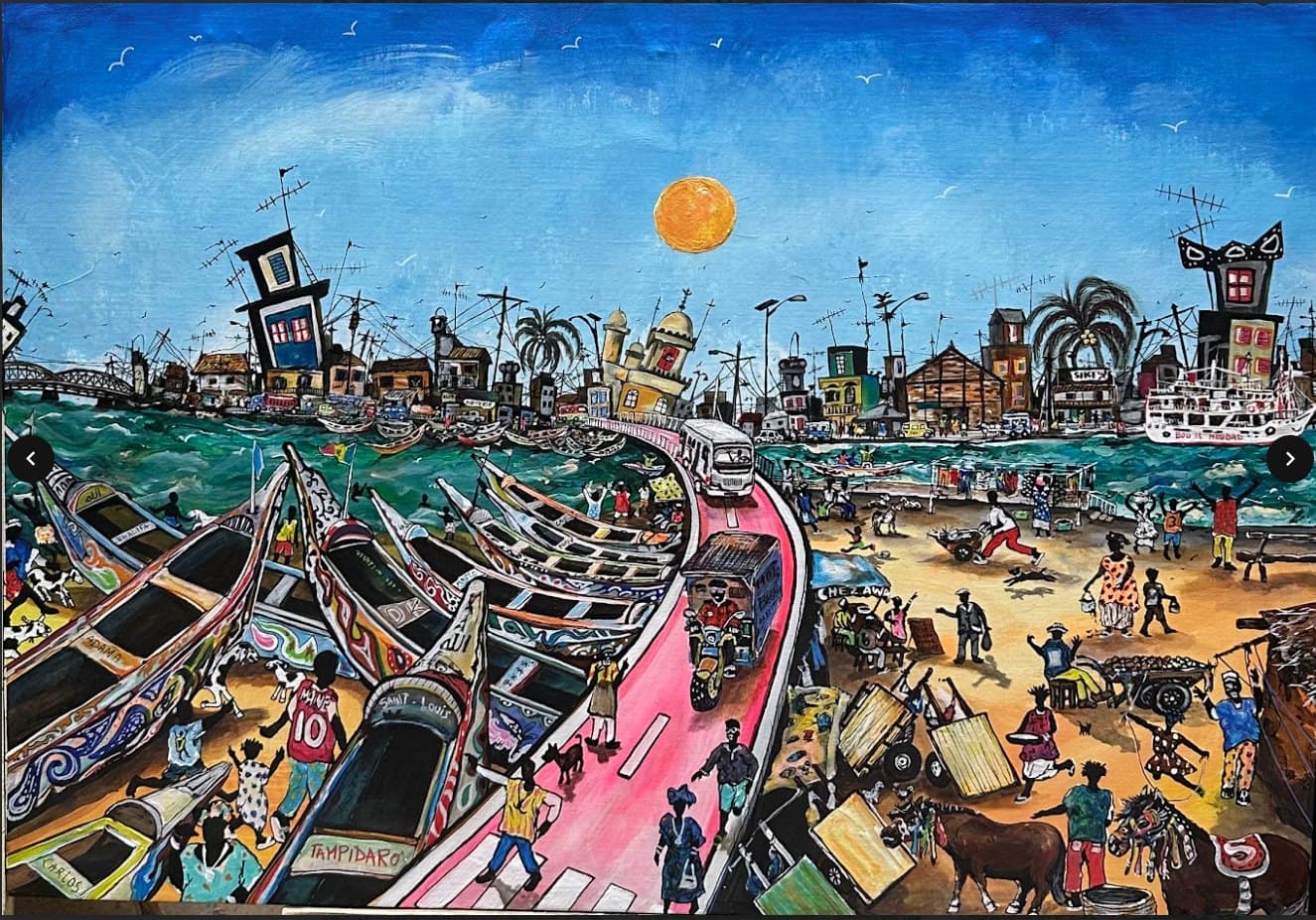
Saint-Louis, Senegal, an island city listed as a UNESCO World Heritage site since 2000 and a former capital of French West Africa, still inspires contemporary art today. At Ge'eza's gallery in Point E, Dakar, artist Tampidaro devotes two 2025 canvases to it: "Saint-Louis" and "Le radeau de Saint-Louis" ("the raft of Saint-Louis"), both in mixed acrylic, 70 x 100 cm.
A city with a recognised past
Saint-Louis was founded in the 17th century at the mouth of the Senegal River, and long served as the capital of French West Africa, before that role moved to Dakar. Its old centre, built on an island, has been a UNESCO World Heritage site since 2000. That international recognition keeps it a subject that painting, photography and film about Senegal return to regularly, well beyond a single generation of artists or a single decade.
The city is also tied to another subject in Tampidaro's work, "Battling Siki" (2025, mixed acrylic, 150 x 110 cm). The boxer, born Amadou M'Barick Fall in Saint-Louis in 1897, beat Georges Carpentier in Paris on 24 September 1922 to become the first world champion born in Africa. He was killed in New York in December 1925, and his remains were brought back to Senegal in 1993.
Saint-Louis as a title, not an origin
In Tampidaro's work, "Saint-Louis" and "Le radeau de Saint-Louis" are titles of works, taken up alongside other, more urban subjects, such as Dakar's roundabouts or the figure of boxer Battling Siki. These are painted subjects, not clues to where the artist was born or lives: the same rule applies to every title of this kind in his online collection, whether it names a city, a landmark or a historical figure.
Two canvases, one format
The two canvases devoted to Saint-Louis share the same format, 70 x 100 cm, the same year, 2025, and the same technique, the mixed acrylic specific to this artist. Their pages are on the gallery site, and the artist's own page is on the artists section, where the price of each piece is given on request. Seeing both canvases together in the gallery lounge is a good way to compare how one subject can give rise to two different titles and two different approaches, rather than judging either piece entirely on its own.
A city between river and ocean
Saint-Louis is a city built between the Senegal River and the Atlantic Ocean, where water is part of the everyday landscape. The title "Le radeau de Saint-Louis" pairs the city with an object of the water, with no need to describe its composition here: the title, technique, format and year are enough to place the work, and the canvas itself is best discovered by looking at it directly at the gallery.
Two canvases, two possible readings
Faced with "Saint-Louis" and "Le radeau de Saint-Louis," a simple comparison is to ask what each title foregrounds: a place, in one case, an object or a more specific scene, in the other. This way of reading two canvases by the same artist, devoted to the same subject but seen from two different angles, applies just as well to these two pieces as to other pairs in the gallery's collection, such as Ibou Diagne's two versions of "Marché hebdomadaire."
Saint-Louis in art, beyond this collection
Saint-Louis holds a particular place in Senegalese cultural history, partly thanks to its preserved colonial-era architecture, partly thanks to its past as a capital. Art venues in Dakar, from the Galerie nationale to private galleries, regularly show work that refers to it in one way or another, though no exhaustive list can be given here, and tastes vary a great deal from one visitor to the next. The article art galleries in Dakar offers wider pointers on where to see art in the capital.
A link to the Lien commun exhibition
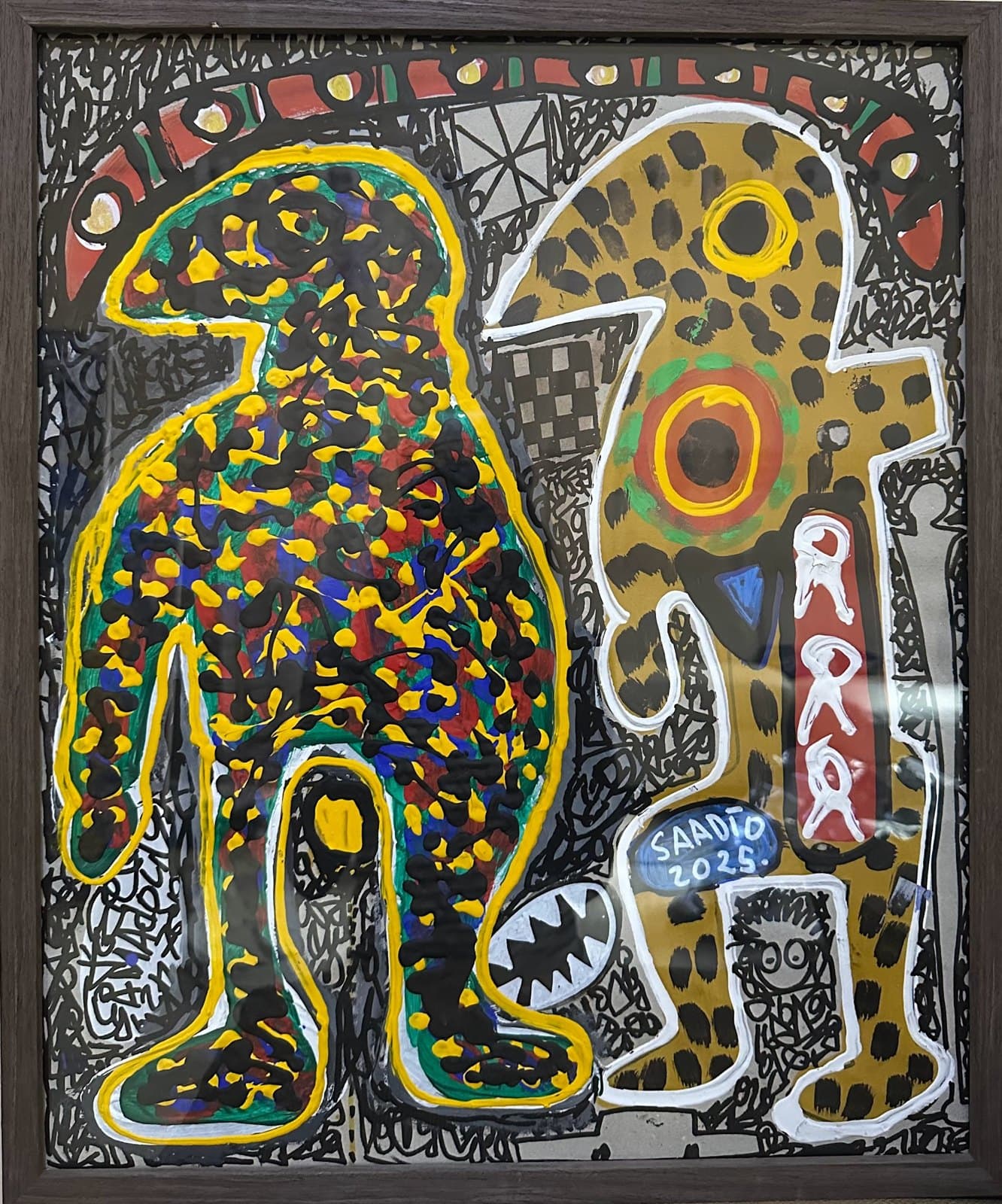
Tampidaro was one of three artists brought together in the group exhibition "Lien commun," presented by Ge'eza at the IFAN Théodore Monod Museum from 16 to 31 October 2025, alongside Saadio and Ibou Diagne, with an opening held on 16 October. The event page for Lien commun keeps a record of that showing, even though the Saint-Louis canvases were not necessarily part of that particular hang at the museum.
Seeing these canvases at the gallery
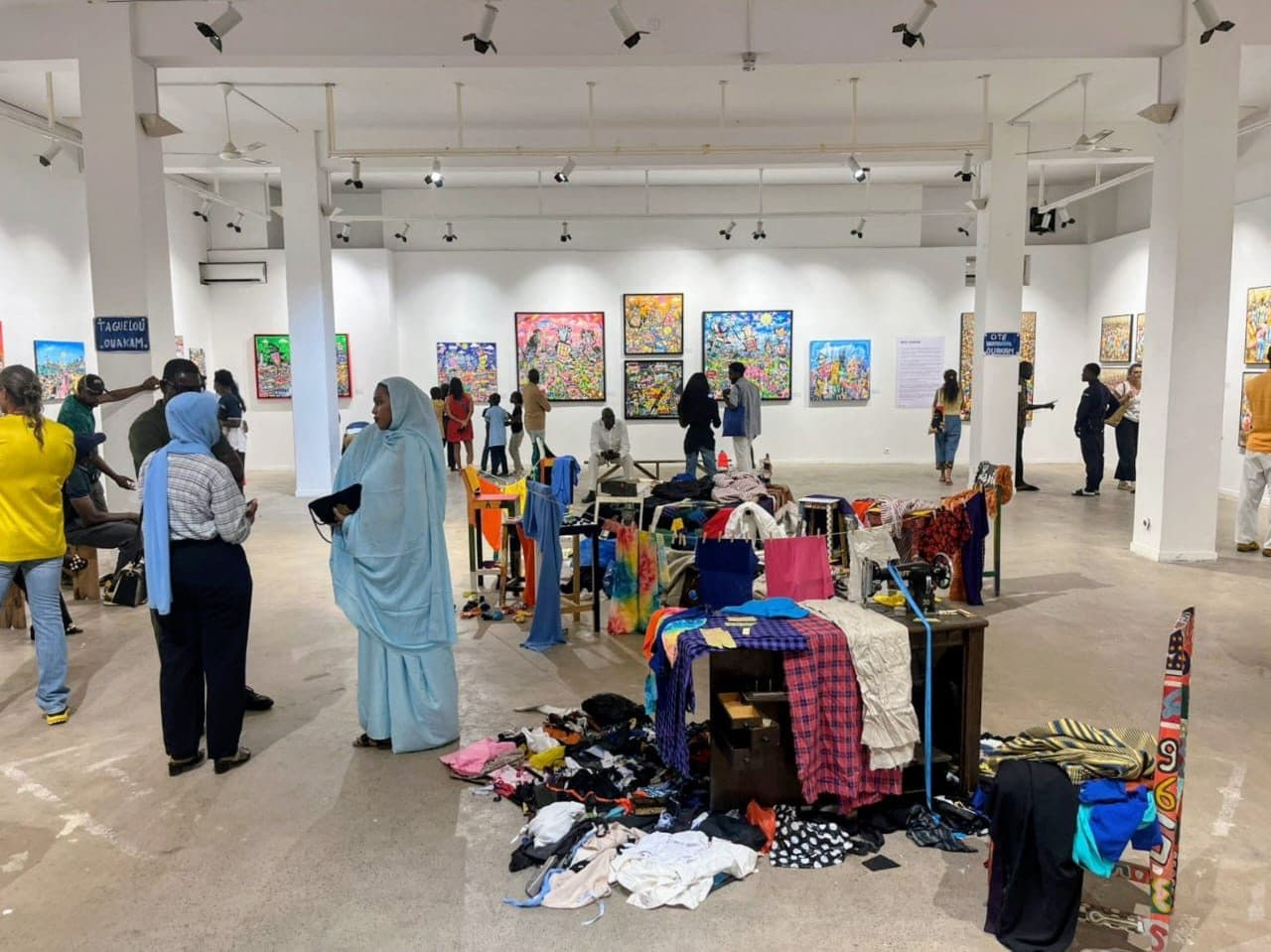
"Saint-Louis" and "Le radeau de Saint-Louis" can be seen at Ge'eza's gallery, at 656 avenue Birago Diop, Point E, Dakar, Tuesday to Sunday, 8am to 10pm, without an appointment, the same hours as the restaurant. For any question about either canvas before you come, write on WhatsApp at +221 78 660 07 07 or to geezacultures@gmail.com.
Asking for the price of one of these works
As with any work in the collection, the price is given on request from the artwork's page, or directly by WhatsApp at +221 78 660 07 07, naming the exact title. The team replies with the amount, the technical details and the certificate of authenticity that comes with every sold work, before any discussion of payment or shipping begins.
Frequently asked questions
Why does Saint-Louis inspire contemporary art?
Because it is a city with a recognised past, a UNESCO World Heritage site that keeps a strong presence in Senegalese cultural memory.
Which Tampidaro works carry this name?
"Saint-Louis" and "Le radeau de Saint-Louis," two mixed acrylic canvases from 2025, in the 70 x 100 cm format.
Is Saint-Louis Tampidaro's birthplace?
No, these are titles of works used by the artist, never a clue to his origin.
How do I find out the price of these canvases?
Ask from the artwork's page on the gallery site, or by WhatsApp at +221 78 660 07 07.