
Dakar · 22 October 2026
Simb, Senegal's False Lion, Painted by Saadio
Simb, a popular Senegalese street tradition built around a false lion, and 'La danse du lion (Simb)', a painting by Saadio in mixed media on kraft paper, framed under glass. What the title means, and how to see the work at Ge'eza's gallery.
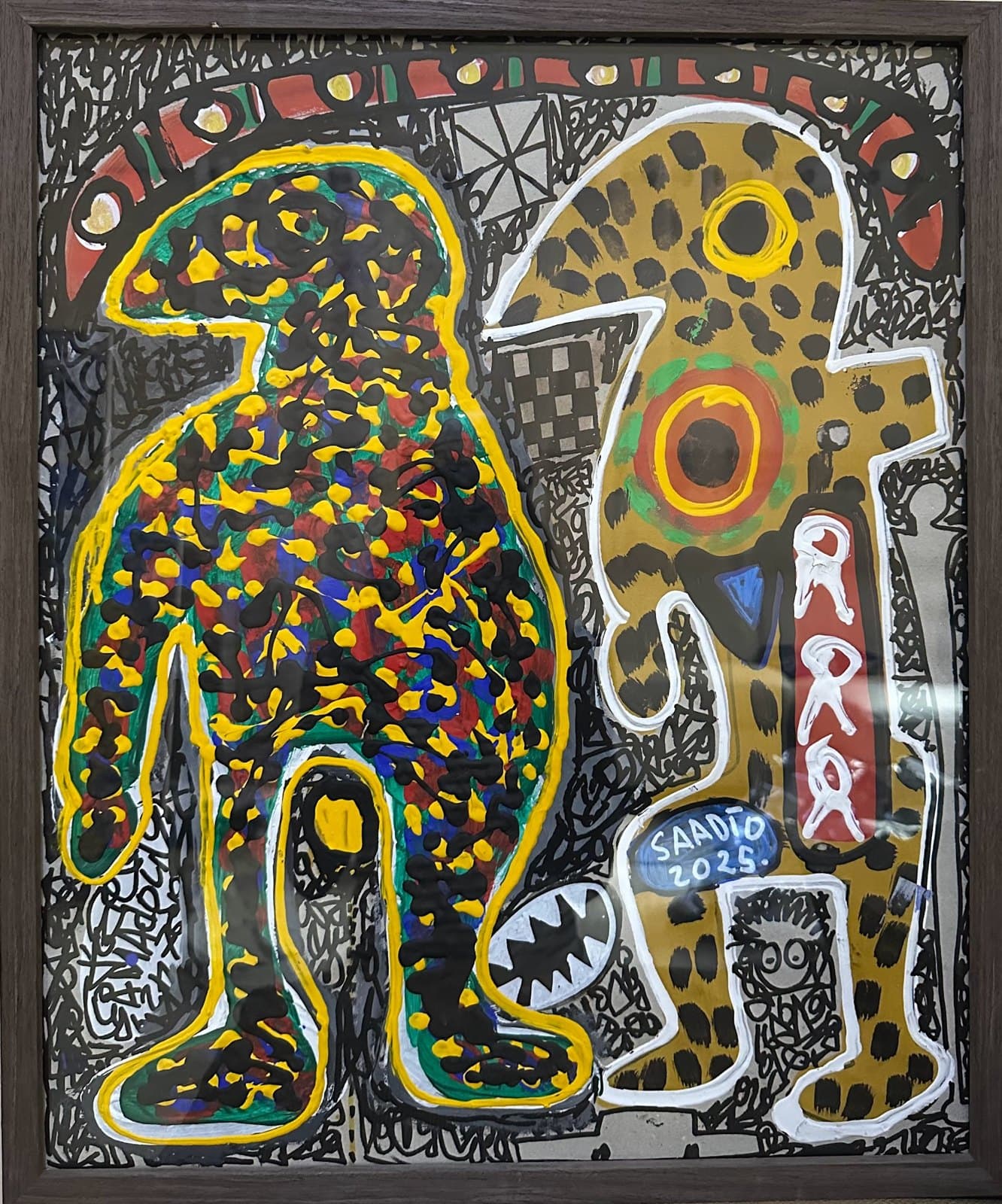
Simb, often called the "false lion," is a popular Senegalese street tradition, named by Saadio in the title of "La danse du lion (Simb)," meaning "the lion dance," mixed media, acrylic and Posca on kraft paper, framed under glass, 60 x 50 cm, made in 2025. The work is available at Ge'eza's gallery, with the price given on request from its page.
Simb, a popular Senegalese tradition
Simb names a street performance in Senegal in which a dancer, costumed and made up as a lion, is surrounded by "tamers" who appear to hold him back in front of a crowd gathered in a circle. Carried by drums and by the game of fear and fascination it keeps up with children and adults alike, this parade is traditionally staged during neighbourhood celebrations, often alongside larger religious or popular festivities. Hence the phrase "false lion" that so often accompanies it: the beast is a man in costume, and everyone knows it.
This tradition remains a widely known cultural reference in Senegal, passed down through generations in certain neighbourhoods, and regularly cited as an example of popular street performance combining costume, dance and drumming.
Simb belongs to a broader category of street performances found, in various forms, across several West African countries: a costumed character, often an animal, moving through a neighbourhood with musicians, whose passage spontaneously draws a crowd of all ages. What sets Simb apart is precisely its open game of imitation: everyone knows the lion is a man in costume, and it is exactly that tension between knowing and spectacle that gives the show its interest, somewhere between staged fright and genuine fascination.
"La danse du lion (Simb)," a painting by Saadio
Saadio chose this subject for a small-format work: mixed media, acrylic and Posca on kraft paper, framed under glass, 60 x 50 cm, made in 2025. The title itself explains the subject in parentheses, a way of clarifying in one word a tradition that might otherwise stay obscure to an unfamiliar audience. The page for the work, La danse du lion (Simb), gives the full technique, size, year and status of the piece, with a photograph of the painting.
This painting belongs to a wider group of Saadio's works on kraft paper, all framed under glass at the same 60 x 50 cm format, whose titles point to several subjects from Senegalese life and culture.
One subject of popular culture among others
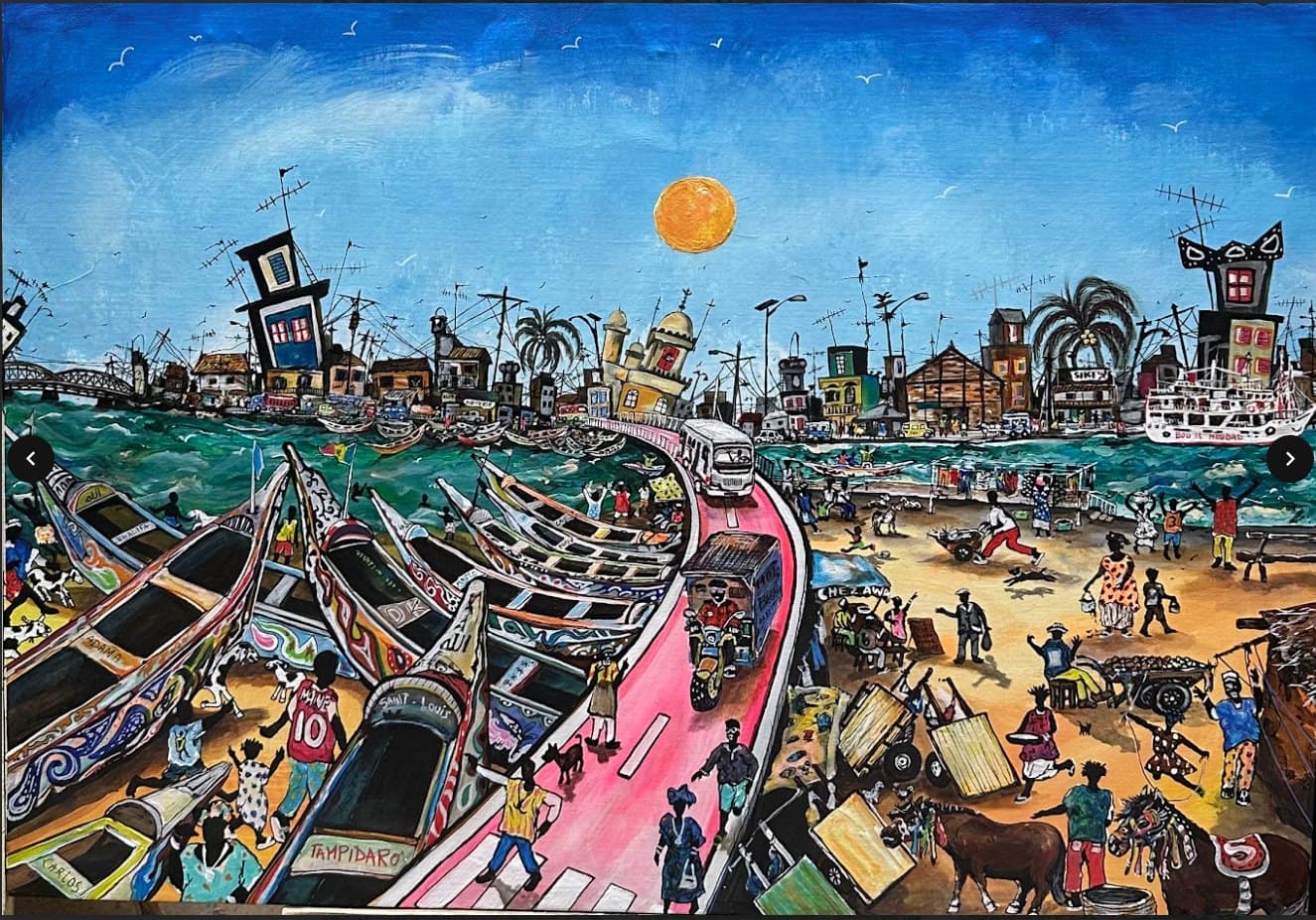
Simb joins, in Saadio's work, other subjects drawn from Senegalese popular culture and daily life, each treated through its own title and painting. This range of references, within the same series of small framed works on paper, can be read first in the list of titles themselves, available on each work's page.
Why a work on paper is shown under glass
Kraft paper, more fragile than canvas stretched on a frame, is protected by being shown under glass, which shields it from dust, humidity and direct handling. In exchange, this presentation calls for care with light: direct sunlight should be avoided, since it can both dull colour and, depending on the type of glass, create a localised magnifying effect if light strikes one part of the work directly. Hanging it in a room with indirect light remains the safest option.
The compact size of these framed works on paper, 60 x 50 cm, also has a practical upside: it travels and hangs more easily than a large canvas, in an entryway, an office or a hallway, without needing an entire wall cleared. It is a size found across several of Saadio's works on kraft paper, meant to be seen up close, at eye level, rather than from across a room.
A tradition, not a biography
It is worth being precise here: Simb is a tradition of Senegalese street performance, and "La danse du lion (Simb)" is a painting that takes it up as a subject. Neither the tradition nor the painting says anything about where Saadio was born, trained or has lived. The subject belongs to a shared popular culture, not to the artist's personal story, in the same way a painter elsewhere might take up a local festival or a well-known public figure without that choice being read as autobiography.
Saadio at the gallery
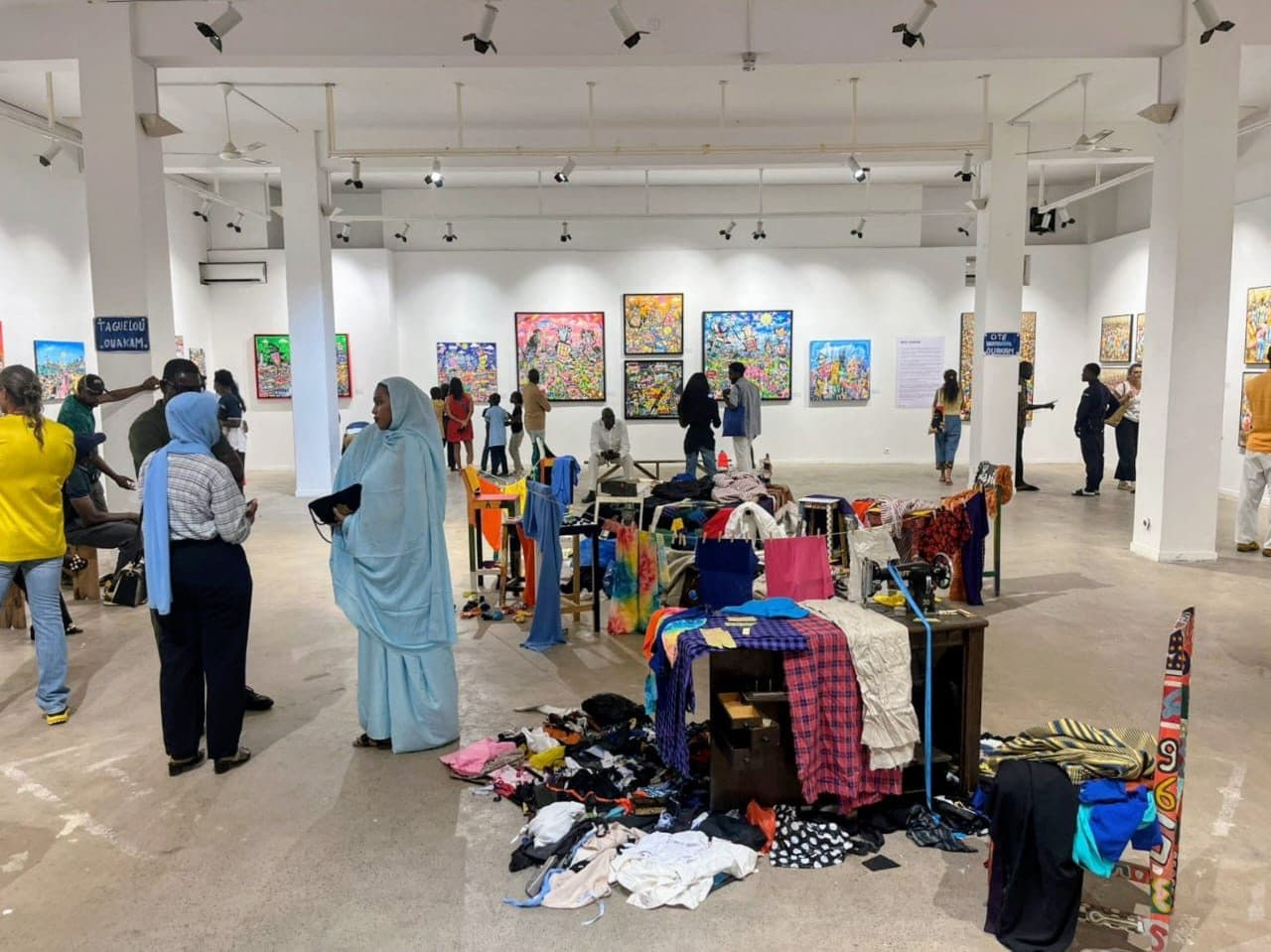
Saadio has been shown at Ge'eza's gallery since the "Lien commun" exhibition in October 2025. His artist page brings together a large body of mixed-media work, on canvas as well as on kraft paper, moving between graphic patterns, urban scenes and subjects drawn from Senegalese popular culture, such as "La danse du lion (Simb)."
Asking for a price and coming to see the work
The price of this work is given on request from its page, or directly on WhatsApp at +221 78 660 07 07, or by email to geezacultures@gmail.com, naming the exact title. The team replies with the price, the technical details and the certificate of authenticity that travels with every work sold. The gallery can be visited without an appointment, Tuesday to Sunday, 8am to 10pm, during the same hours as the restaurant, at 656 avenue Birago Diop, Point E.
Frequently asked questions
What is Simb?
A popular Senegalese street tradition, a dancer costumed as a lion surrounded by tamers in front of a crowd, often called the "false lion."
Which Saadio work takes up this subject?
"La danse du lion (Simb)," mixed media on kraft paper, framed under glass, 60 x 50 cm, made in 2025.
Why is this work shown under glass?
Because it is made on kraft paper, a more fragile material than canvas, which glass protects from dust and humidity.
How do I find out the price of this work?
From its page on the gallery site, or on WhatsApp at +221 78 660 07 07.
Can this work be seen without an appointment?
Yes, the gallery is open during the restaurant's hours, Tuesday to Sunday, 8am to 10pm.