
Art · 22 October 2026
The Market as a Subject in Senegalese Contemporary Painting
The market is one of the most recurring subjects in Senegalese contemporary painting. At Ge'eza's gallery, Ibou Diagne devotes about ten canvases to it, including La foule, on view and for sale in Point E.
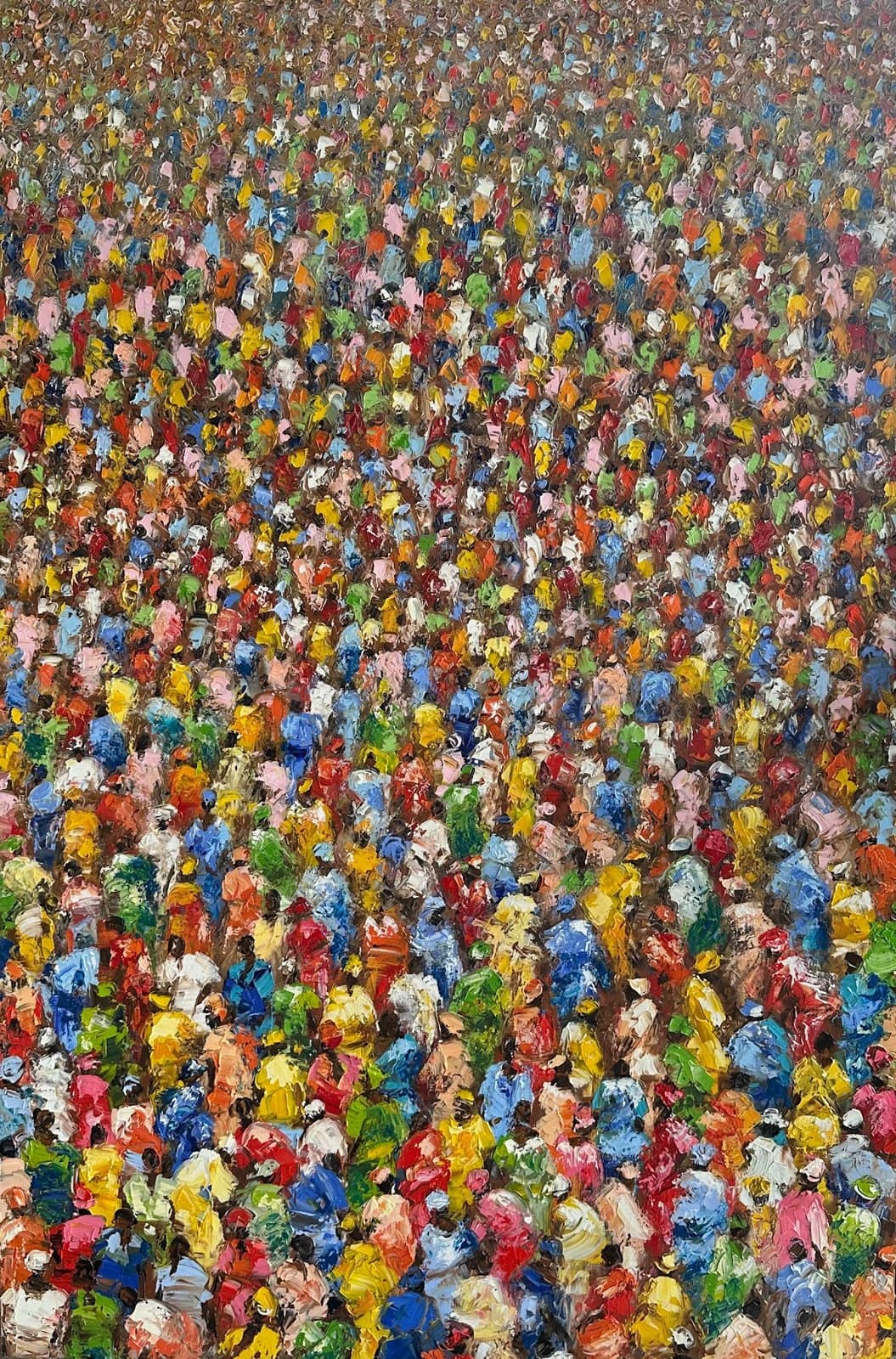
The market is one of the most recurring subjects in Senegalese contemporary painting, and this is especially true of Ibou Diagne's work, shown at Ge'eza's gallery in Point E, Dakar. Among his 22 works online, about ten return directly to this theme, including "La foule" (2025, oil on canvas, 180 x 120 cm, its title meaning "the crowd"), currently available, its price given on request.
An old subject, still painted
The market, a place of trade but also of meeting and movement, is a long-standing motif in West African painting, taken up by many artists across generations. It gathers, on a single canvas, figures, objects, gestures and a kind of collective motion, without the artist needing to invent a scene: the market offers dense visual material on its own.
Ibou Diagne's market scenes
In Ibou Diagne's work, the market takes several forms. General scenes: "Marché de Louga" (2023), "Marché hebdomadaire" (2023) and its 2025 counterpart, "Jour de marché" (2025), "Marché aux poissons" (2025, oil, 180 x 120 cm). Figures of the market, isolated on a canvas: "Vendeuses de poissons," "Vendeurs de café," "Les vendeuses de légumes," "Vendeurs d'oranges," "La table de Mère Awa" and "Marchand ambulant," all from 2025. Louga, as a subject, comes up more than once in this body of work, without this being read as the artist's origin or where he lives.
La foule, a large format
"La foule" holds a particular place in this group: at 180 x 120 cm, it is one of Ibou Diagne's largest canvases online, and one of the few titled not after a specific market activity but after the movement of the group itself. Its page is on the gallery site; it is currently available.
The market in Tampidaro's work too
Ibou Diagne is not the only gallery artist to paint the market, and his own page is on the artists section. Tampidaro, in a more urban register, devotes several titles to street trade in Dakar: "Marché Sandaga" (100 x 120 cm), "Le marché de Colobane" and "Le marché de Thiaroye," all in mixed acrylic, 2025.
What to look for in a painted market scene
In front of a market canvas, three habits help you slow down. Composition: how figures and stalls occupy the surface, in bands, in depth, or in a loose circle. Material: oil often keeps a texture that acrylic, flatter and sharper, does not try to copy. Rhythm: how the eye moves from one figure to the next without a fixed path. These habits apply to any market canvas, Ibou Diagne's or another painter's.
Why this subject comes back so often
The market gathers, in a single scene, everyday gestures recognisable to many visitors: selling, weighing, carrying, talking. It is also a subject that renews itself from one canvas to the next, since the same place can be painted from very different angles depending on the time of day or the viewpoint chosen, without the artist needing to change theme. That is likely why several of Ibou Diagne's titles return to the same market across different years: "Marché hebdomadaire" exists in two versions, 2023 and 2025, neither a repeat of the other, each a distinct composition with its own format.
A subject that crosses techniques
The market does not stick to one technique. In Ibou Diagne's work, some market canvases are in oil, such as "Marché aux poissons," others in acrylic, such as "Jour de marché" or "Marché hebdomadaire 2." This range shows that the same subject can carry very different textures, depending on the artist's choice for a given canvas rather than on a fixed rule, and it is part of why visitors often come back to look twice at pieces they had first passed by.
One market, several visits
Beyond the titles themselves, it is worth remembering that a market painted in 2023 and the same market painted again in 2025 are two separate decisions by the artist, not a single subject revisited out of habit. Seeing both versions side by side, when they are on display together, is one of the more interesting ways to spend time at the gallery, since it shows how a painter's hand and choices can shift over two years while the underlying subject stays recognisable.
Buying a market scene
Prices for these canvases, like any work in the gallery, are given on request from their page, or by WhatsApp at +221 78 660 07 07. The guide Senegalese reverse glass painting covers another traditional technique, souwère, where the market and everyday scenes are also a frequent subject.
Seeing these canvases at the gallery
Ge'eza's gallery can be visited without an appointment, Tuesday to Sunday, 8am to 10pm, at 656 avenue Birago Diop, Point E. For any question about a particular market canvas before you come, write on WhatsApp at +221 78 660 07 07 or to geezacultures@gmail.com.
Frequently asked questions
Which Ibou Diagne works show a market?
"Marché de Louga," "Marché hebdomadaire," "Jour de marché," "Marché aux poissons," as well as canvases devoted to vendors and traders.
Is La foule available?
Yes, this 180 x 120 cm oil on canvas (2025) is currently available, price on request.
Does Tampidaro paint markets too?
Yes, in a more urban register, with "Marché Sandaga," "Le marché de Colobane" and "Le marché de Thiaroye."
How do I find out the price of one of these canvases?
Ask from the artwork's page, or by WhatsApp at +221 78 660 07 07.