
Art · 22 October 2026
Dakar's Urban Culture in Tampidaro and Saadio's Painting
Titles such as 'Break dance sous le pont', 'Laisse-moi passer, way !', 'Attention, maman traverse !', 'Même pas fatigué !' by Tampidaro, 'Tik Tok' and 'Ma moto' by Saadio: Dakar's urban culture in two artists' titles at Ge'eza's gallery.
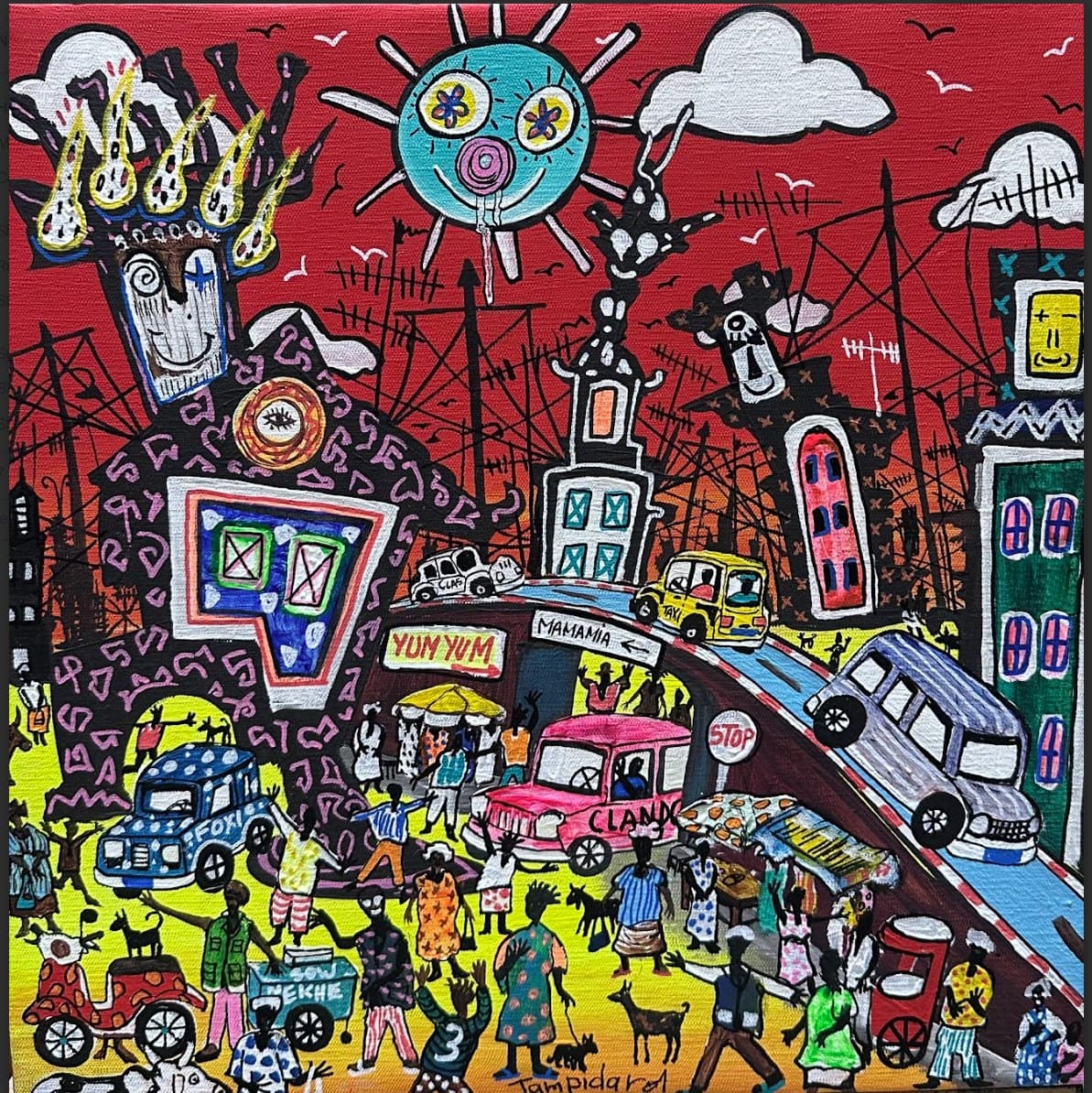
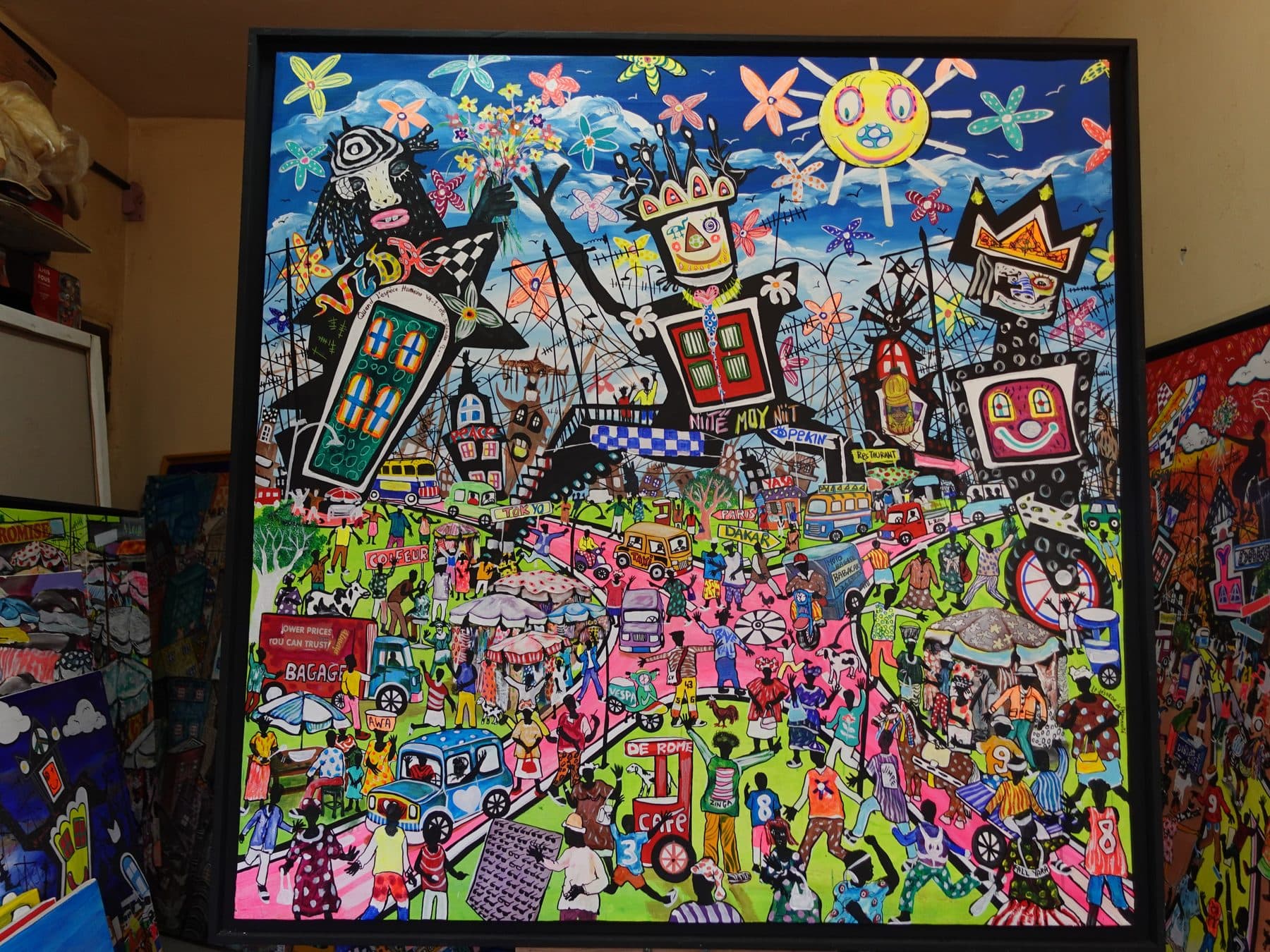
"Break dance sous le pont" (break dance under the bridge), "Laisse-moi passer, way !," "Attention, maman traverse !" (watch out, mum is crossing) and "Même pas fatigué !" (not even tired) are four paintings by Tampidaro, at 50 x 50 cm, which name scenes of Dakar street life with spoken phrases rather than neutral titles. Alongside them, "Tik Tok" and "Ma moto" (my motorbike), by Saadio, name two equally contemporary objects or practices. All six works are available at Ge'eza's gallery, with the price given on request from each page.
Titles that speak like the street
What stands out in these four Tampidaro titles is how close they sit to spoken language: "Laisse-moi passer, way !" and "Attention, maman traverse !" read like sentences overheard on the street rather than museum labels, with punctuation that carries the exclamation into writing. "Même pas fatigué !" picks up a familiar phrase that could come from a child or a teenager after physical effort. "Break dance sous le pont" names an urban practice directly, hip-hop dance, in one specific place in the city, under a bridge, often associated with young dancers claiming urban spaces as their own.
All four paintings are in mixed acrylic, all at the same 50 x 50 cm size, and all dated 2025. The page for "Break dance sous le pont" gives the full technique, size and status of this work, with a photograph.
"Tik Tok" and "Ma moto," two contemporary objects by Saadio
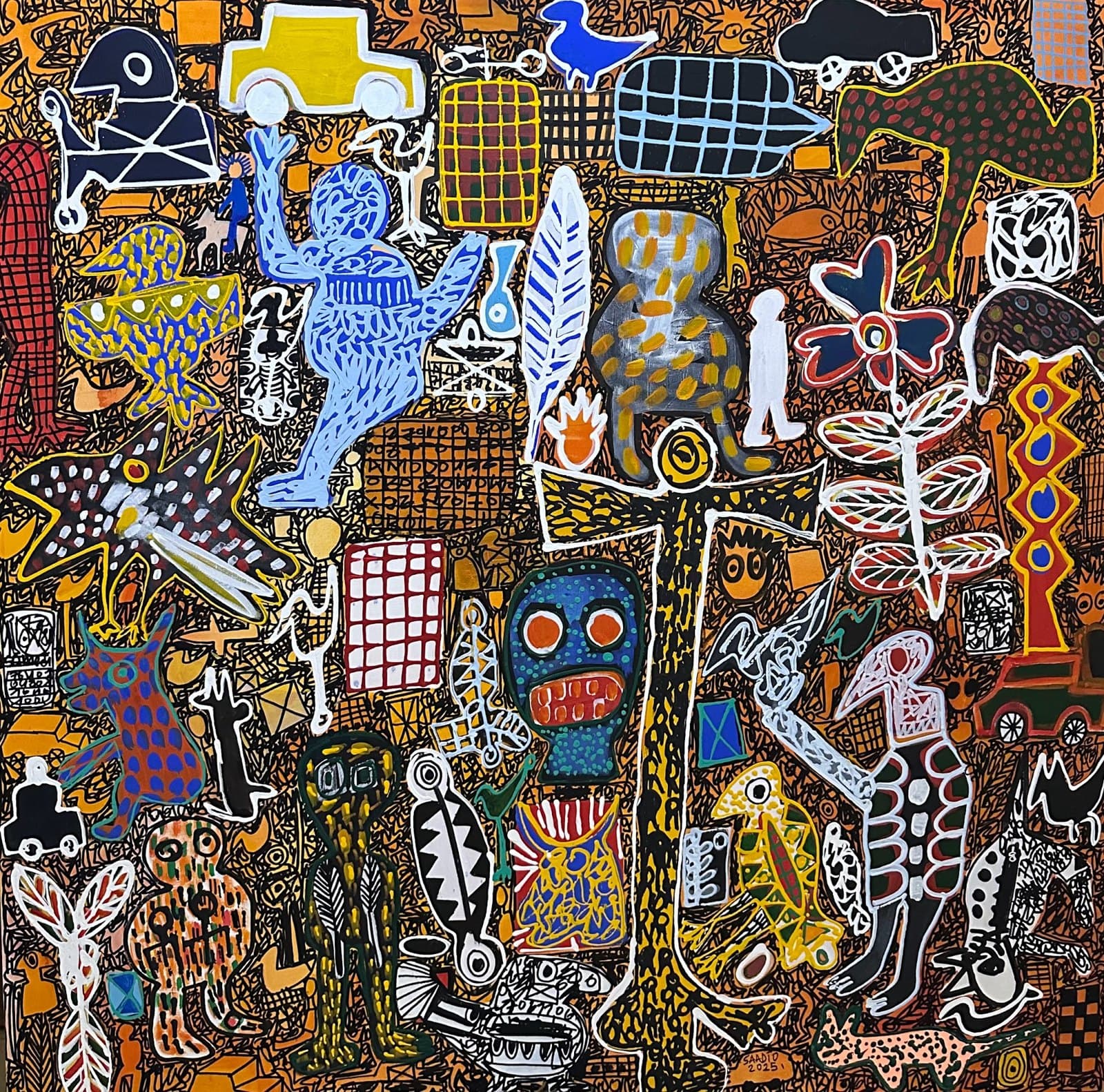
On Saadio's side, "Tik Tok" and "Ma moto," mixed media, acrylic and Posca on kraft paper, framed under glass, 60 x 50 cm, made in 2025, also name very contemporary things: a social media app turned global cultural phenomenon, and an everyday object, the motorbike, a widely used mode of transport in Dakar. The page for "Tik Tok" states the technique and status of this work, made on a different support from Tampidaro's canvases.
Two artists, two formats, one shared grounding in the present
These six titles, whether from Tampidaro or Saadio, share one thing in common: they draw on today's vocabulary and practices rather than a more timeless evocation of the city. The format, however, differs between the two artists. Tampidaro here works at 50 x 50 cm on canvas, a small mixed acrylic square, while Saadio chooses kraft paper under glass, also a small format, at 60 x 50 cm. These small sizes, for both artists, travel and hang easily, in an entryway, a hallway or an office.
It is worth noting that, for both Tampidaro and Saadio, the same size often repeats for related subjects: Tampidaro's four 50 x 50 cm paintings on urban culture echo, in spirit, Saadio's 60 x 50 cm kraft paper series, each forming a small, consistent group within the artist's output.
A different register from markets and roundabouts
These six works stand apart from other subjects found at the gallery, such as markets or roundabouts, which tend to picture a place or a recurring activity. Here, the subject is closer to a moment, a phrase or a gesture: a dancer under a bridge, a shouted warning to let someone pass, a child's boast after running around. That shift in register, from place to moment, says something about how wide a range of subjects two painters working from the same city can cover.
Why urban culture as a subject
Painting contemporary urban culture, whether a practice like break dance or an object like a phone tied to a social media app, anchors a work in a specific moment rather than a general evocation of the city. This choice sets these paintings apart from other series more focused on markets or historical places, and shows the range of subjects taken on by the artists shown at the gallery.
Caring for these small formats
Tampidaro's canvases, in mixed acrylic on canvas, are cared for like any acrylic painting: kept away from direct sunlight, in a room with stable humidity. Saadio's works on kraft paper, protected under glass, additionally need to avoid any direct sunlight on the frame, which could create a localised magnifying effect.
Tampidaro and Saadio at the gallery
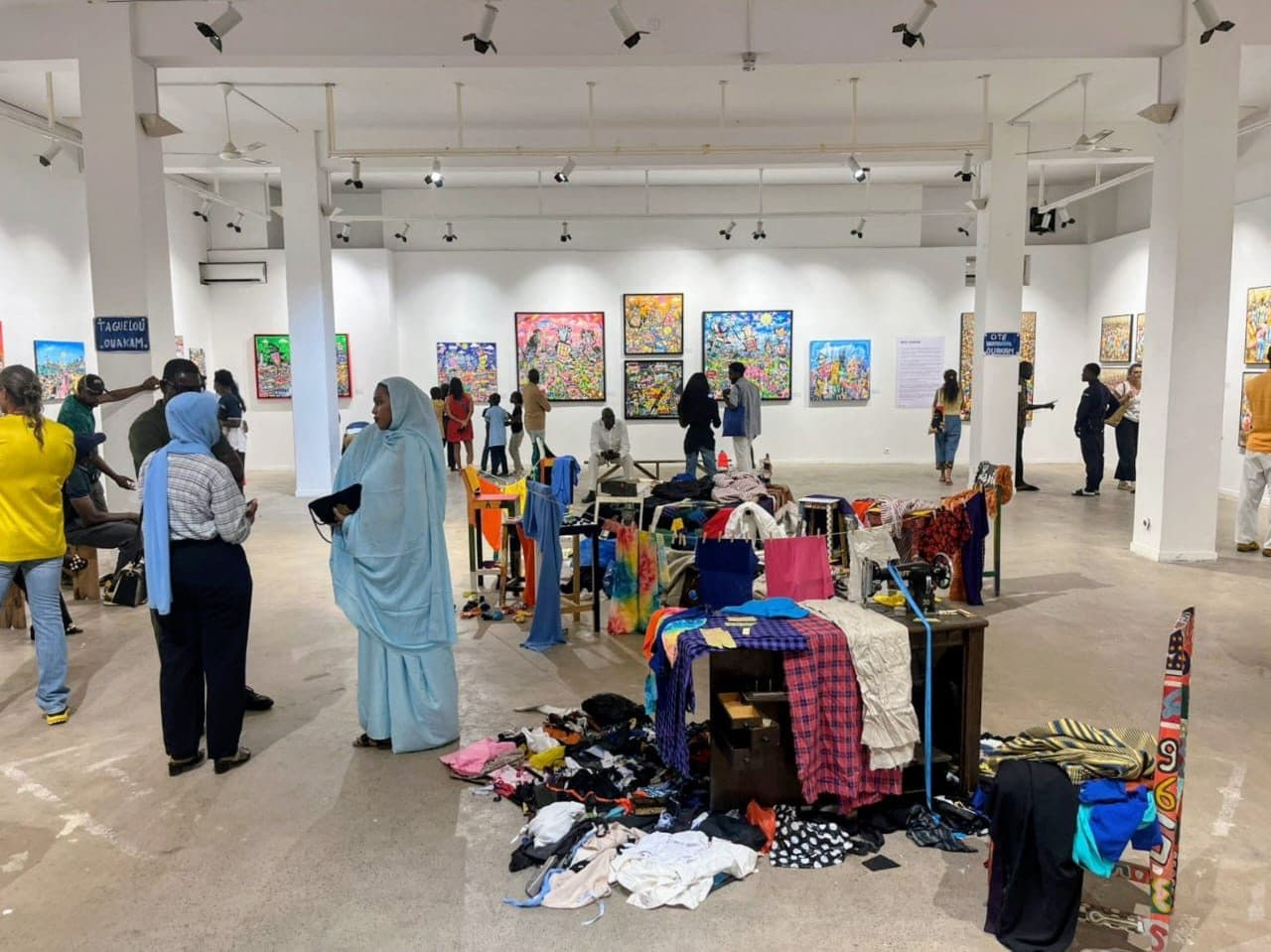
Tampidaro and Saadio have both been shown at Ge'eza's gallery since the "Lien commun" exhibition in October 2025. Tampidaro's artist page brings together his full body of paintings on urban Dakar, while Saadio's page gathers his mixed-media work, on canvas as well as on kraft paper.
Asking for a price and coming to see the works
The price of each of these six works is given on request from its page, or directly on WhatsApp at +221 78 660 07 07, or by email to geezacultures@gmail.com, naming the exact title and artist. The team replies with the price, the technical details and the certificate of authenticity that travels with every work sold. The gallery can be visited without an appointment, Tuesday to Sunday, 8am to 10pm, during the same hours as the restaurant, at 656 avenue Birago Diop, Point E.
Frequently asked questions
Which Tampidaro paintings evoke Dakar's urban culture?
"Break dance sous le pont," "Laisse-moi passer, way !," "Attention, maman traverse !" and "Même pas fatigué !," four mixed acrylic works at 50 x 50 cm, 2025.
Which Saadio works round out this group?
"Tik Tok" and "Ma moto," mixed media on kraft paper under glass, 60 x 50 cm, 2025.
Why do these titles sound like spoken phrases?
Because they borrow expressions heard on the street, a way of anchoring the paintings in everyday life in Dakar.
How do I find out the price of one of these works?
From its page on the gallery site, or on WhatsApp at +221 78 660 07 07.
Can these works be seen without an appointment?
Yes, the gallery is open during the restaurant's hours, Tuesday to Sunday, 8am to 10pm.