Dakar · 22 October 2026
Senegal's Creative Economy: A Panorama of Culture and Art
A panorama of Senegal's cultural and creative industries: the public FDCUIC fund, the Dak'Art Biennale, Dakar's museums and venues, private galleries, and the place of a hub that combines art, food and retail.
Senegal's cultural and creative industries bring together a dedicated public fund (the FDCUIC), a major fixture for contemporary art (the Dak'Art Biennale), museums and creative venues in Dakar, and a network of private galleries, including hubs that blend art, food and retail. This ecosystem has built up over several decades, from the 1966 World Festival of Black Arts to the most recent editions of the Biennale.
A public fund to structure the sector
Senegal runs a public fund, the FDCUIC (Fonds de développement des cultures urbaines et des industries créatives), aimed at supporting initiatives in this field. Its existence signals a political choice to treat culture as an economic sector in its own right, beyond supporting artists alone. This fund's criteria, calls for projects and amounts are published on its official site when the time comes.
The Dak'Art Biennale, a reference point
The Dak'Art Biennale is the most recognised fixture in Senegal's contemporary art calendar. Its 15th edition ran from 7 November to 7 December 2024, postponed from May, under the theme "The Wake." A 16th edition is announced by the organisers for 19 November to 19 December 2026, under the theme "(Anti)fragility." Around the official Biennale, a parallel Off programme traditionally takes place, for which venues can register without any selection process, according to the event's official site. Our Dak'Art Biennale guide explains how the event works.
Museums, creative venues and institutions
Dakar brings together several institutions that structure the art scene: the Museum of Black Civilisations, opened in 2018, the Village des arts, home to artists' studios, the Galerie nationale, and the Institut français's Le Manège gallery. RAW Material Company, founded in 2008, is an independent space devoted to contemporary art and research. Alongside these sit several private galleries, best described in general terms rather than ranked: each has its own focus and its own audience. The article on cultural institutes in Dakar rounds out this picture on the foreign institutions side.
A scene carried by a market in motion
The market for modern and contemporary African art has seen a notable recovery at auction: 62.8 million dollars in 2025, up 42.6 percent on the 43.9 million recorded in 2024, according to the ArtTactic report of April 2026. That recovery is driven mainly by modern artists and southern Africa, a useful signal for understanding the context the Senegalese scene sits within, rather than a figure specific to the country.
The place of a hub that blends art, food and retail
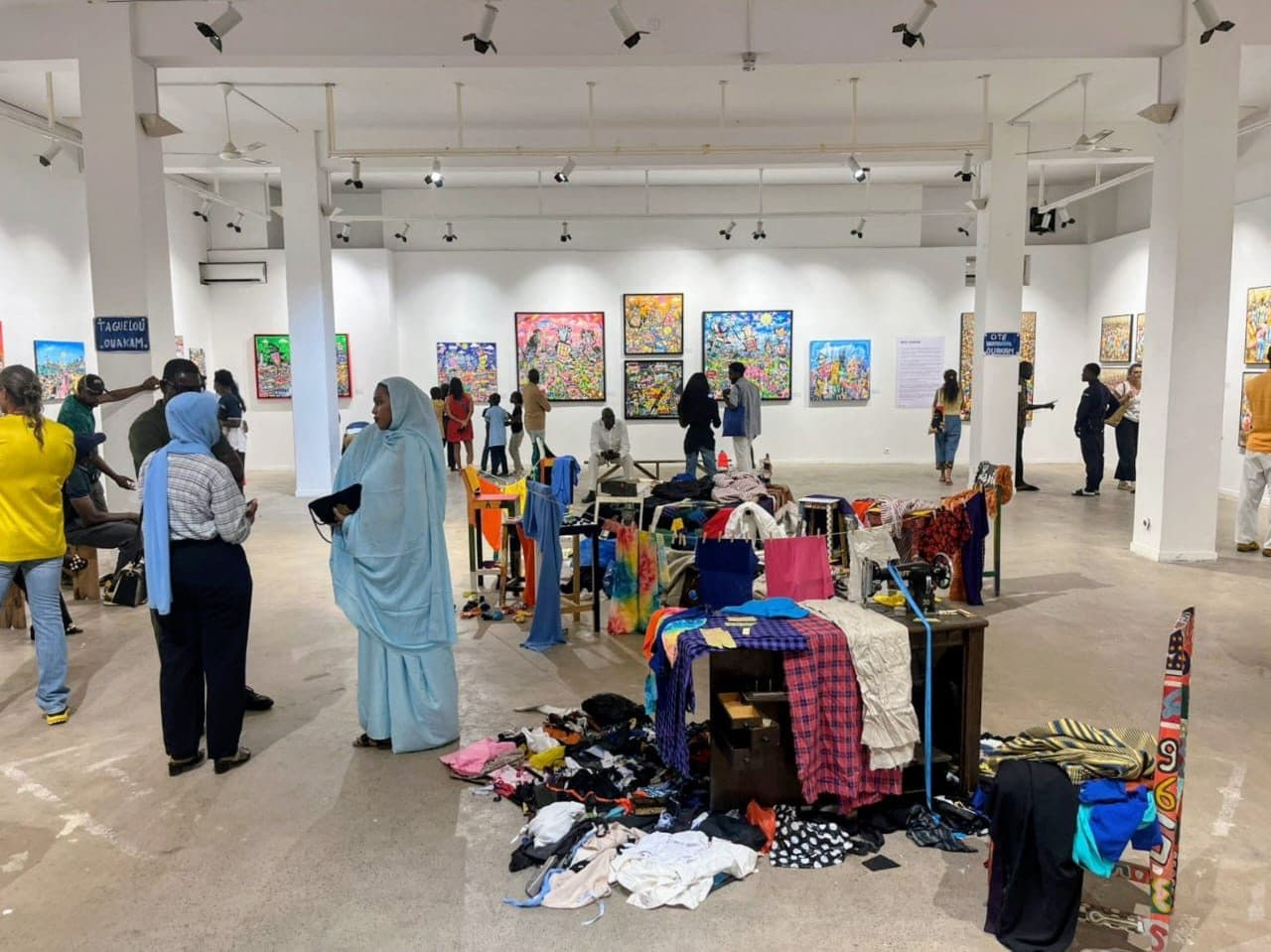
Within this landscape, some private venues choose not to limit themselves to a single function. Ge'eza, in Point E, brings a restaurant, a contemporary art gallery and a concept store together under one roof, with programming that has already hosted exhibitions and craft markets. That combination gives a visitor the chance to discover contemporary art in a less formal setting than a museum, over a meal or a coffee ceremony. Our about page sets out the house's history and vision within this wider context.
A sector that goes beyond galleries alone
Cultural and creative industries are not limited to the visual arts: they also cover music, film, craft, publishing and design, all fields the FDCUIC is meant to support. In Dakar, that range shows up in craft workshops, music production houses and concept stores that sell local work alongside galleries. Understanding the sector as a whole helps place a venue such as a gallery or a cultural hub, which only accounts for part of it.
What this panorama leaves out
This panorama only names institutions whose existence is verified and figures with a named source: it ranks no venue, announces no future edition date beyond the one already communicated by the Biennale's organisers, and presents no private venue as the recipient of public funding or an institutional partnership.
Reading beyond the headline figures
Market figures such as the auction totals above describe a global or continental trend, not a guaranteed outcome for any single gallery or artist in Dakar. They are useful for understanding the direction a sector is moving in, but say nothing about how a particular piece or a particular career will fare. Treat them as background, not as a forecast.
An ecosystem worth visiting too
For a visitor curious about this sector, nothing replaces seeing the venues in person: a stop at the Museum of Black Civilisations, an afternoon at the Village des arts, then a visit to one or two private galleries give a livelier sense of the scene than any figure could. Many of these venues can be visited freely during opening hours, with no need to book ahead.
Taking it further
For any question about Ge'eza's place in this ecosystem, or a project combining art, food and retail in Dakar, the team replies on WhatsApp at +221 78 660 07 07 or at geezacultures@gmail.com.
Frequently asked questions
What is the FDCUIC?
The Fonds de développement des cultures urbaines et des industries créatives, a Senegalese public fund aimed at supporting initiatives in this sector, whose criteria are published on its official site.
When is the next Dak'Art Biennale?
A 16th edition is announced by the organisers for 19 November to 19 December 2026, under the theme "(Anti)fragility."
Which venues structure Dakar's art scene?
The Museum of Black Civilisations, the Village des arts, the Galerie nationale, the Institut français's Le Manège gallery, RAW Material Company, and several private galleries.
What does a venue like Ge'eza bring to this ecosystem?
A setting that brings together a restaurant, a gallery and a concept store, where visitors can discover contemporary art in a less formal context than a museum, with no public funding or institutional partnership attached to it.