
Dakar · 6 October 2026
The Battle of Adwa, 1896: Ethiopia's Victory and Africa
Adwa, 1 March 1896: the Ethiopian army of Menelik II defeats the Italian army. Why this victory is a Pan-African symbol and what it says about Ethiopia's ties with the rest of the continent.
On 1 March 1896, near Adwa in northern Ethiopia, the army of Emperor Menelik II defeated the Italian army. The victory let Ethiopia remain independent at a time when most of the continent was being divided among European colonial powers. It became a Pan-African symbol: that of an African country that stood up to a European army. This article sticks to widely established facts and to what the battle says about Ethiopia's links with the rest of Africa.
The background
At the end of the nineteenth century European powers were carving up Africa, a movement associated with the Berlin Conference of 1884 to 1885 and the years that followed. Italy, seeking to build a colonial empire, settled on the Red Sea coast in Eritrea and eyed Ethiopia.
In 1889 Italy and Ethiopia signed the Treaty of Wuchale. Its Italian and Amharic versions differed on one clause, the famous Article 17: in the Italian text Ethiopia was to go through Italy for its foreign relations, which amounted to a protectorate. In the Amharic text it was only an option. Menelik II rejected the Italian reading, and the disagreement led to war.
The battle
Ethiopian forces, gathered by Menelik II, met the Italian army, commanded by General Baratieri, on 1 March 1896 near Adwa. The outcome was a heavy defeat for Italy. Empress Taytu Betul, Menelik's wife, is generally credited with an important role in mobilising and sustaining the campaign.
We give no figures for troop numbers or losses, because estimates vary between sources. What is established is the result: an Ethiopian victory.
The consequences
A few months later, in October 1896, the Treaty of Addis Ababa recognised Ethiopia's independence. The country remained one of the few African states not colonised in that period. An Italian occupation took place later, from 1936 to 1941, but it did not erase the symbol of Adwa, and Ethiopian independence was restored.
Every year Ethiopia commemorates the Adwa victory, in early March.
A Pan-African symbol
Why does this battle resonate far beyond Ethiopia? Because it showed that an African state could resist a European army. Through the twentieth century it fed the idea of African pride and of solidarity between the peoples of the continent.
The green, yellow and red of the Ethiopian flag inspired the emblems of several African movements and countries, and are often cited as the colours of Pan-Africanism. Addis Ababa hosted the founding of the Organisation of African Unity in 1963, now the African Union, which is still headquartered there. To read further, see Ethiopia and Senegal's historic ties and Pan-Africanism and contemporary art.
Adwa seen from Dakar
Why talk about Adwa in a Dakar guide? Because symbols travel. African young people, in Senegal as elsewhere, know this history as a story of dignity. A place like Ge'eza, in Point E, presents itself as a bridge between two Africas, the Ethiopian and the Senegalese. Knowing Adwa helps explain why Ethiopia holds a particular place in the continent's imagination.
It would be a mistake to reduce everything to one battle. Ethiopia is also a country of books, churches, writing and coffee. The battle is one landmark among others, but the one that most marked memories beyond its borders.
From story to table
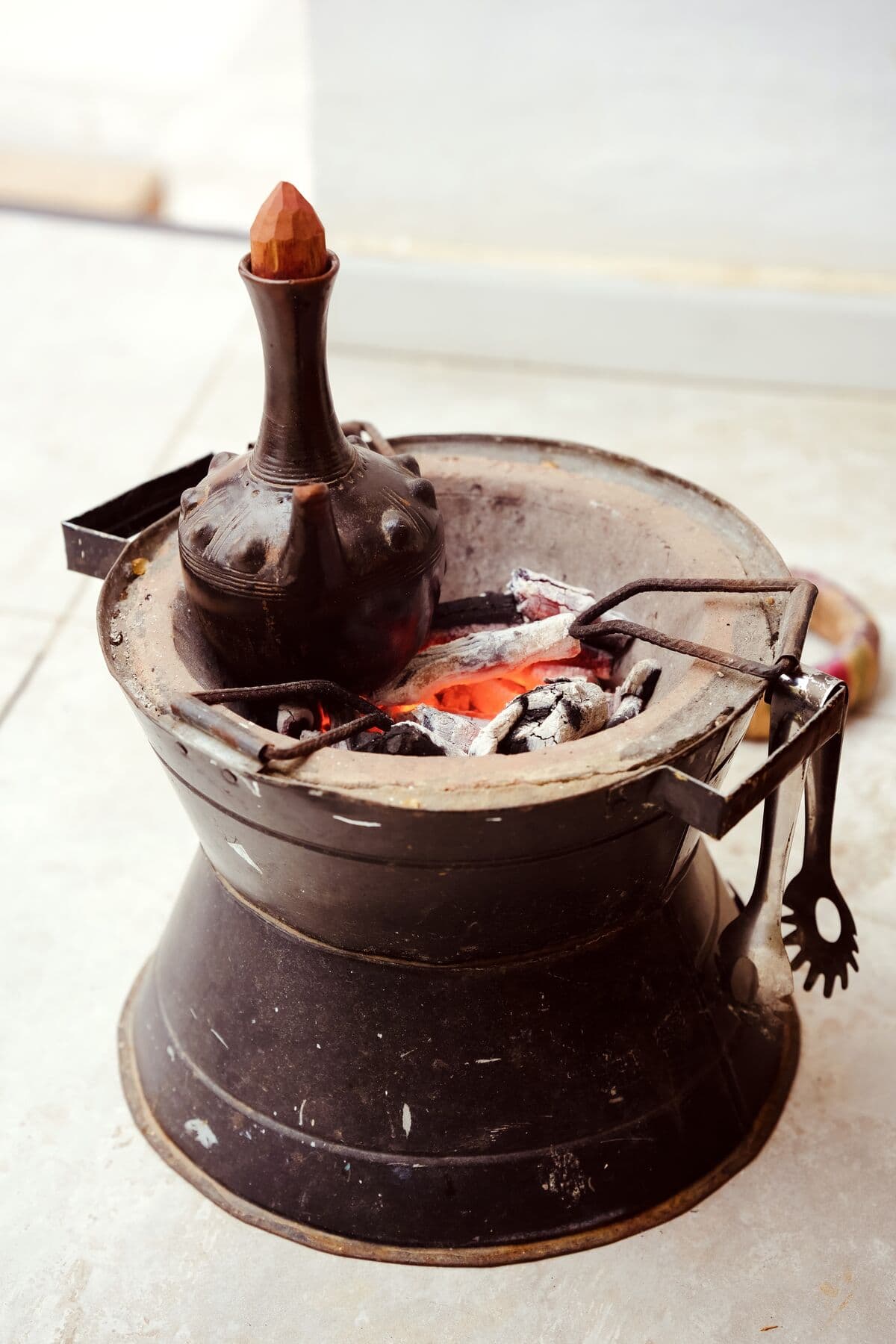
History is learned from books, but it is also handed on through gestures. At Ge'eza, the Ethiopian coffee ceremony is one example: the coffee is roasted, hand-ground and brewed in a clay jebena, then served in three rounds, Abol, Tona and Baraka, about 45 minutes in all, at 5,000 F per person (Abol 2,500, Tona 2,000, Baraka 1,500). It is a time for talking, and conversation often drifts to history. It is best booked 24 hours ahead, especially for a group, with confirmation by WhatsApp. Details are on the coffee ceremony page.
To go further
Some useful reading to extend this entry: history books on Ethiopia and on the colonisation of Africa, studies of Pan-Africanism, and accounts by Ethiopian and African historians of the period. Choose sources that cite their references, as the battle has produced many contradictory figures.
Visiting Ge'eza
The house is open Tuesday to Sunday, 8am to 10pm, at 656 avenue Birago Diop, Point E, and closed on Monday. To learn more about the place and its project, the about page introduces the founder, Maraki Germa Bekele, and the idea behind the house.
Reading about it without getting lost
Accounts of the battle vary between authors, viewpoints and eras. To find your way, compare several sources, note the dates and names that appear everywhere (Menelik II, Empress Taytu, 1896) and be wary of overly precise figures. The essentials fit in a few words, and the rest is a matter of nuance.
A good habit is to read one account by an Ethiopian author and one by a European historian, then see where they agree. The overlap is the solid ground, and the differences show you how the same event has been told from several sides.
Frequently asked questions
When did the Battle of Adwa take place?
On 1 March 1896, near Adwa in northern Ethiopia.
Who won?
The Ethiopian army of Emperor Menelik II defeated the Italian army.
Why is it a Pan-African symbol?
Because it showed that an African state could resist a European army and keep its independence in the era of colonial partition.
Was Ethiopia always independent?
It kept its independence, apart from an Italian occupation from 1936 to 1941, after which independence was restored.