
Guide · 27 October 2026
Rekebot and Sini: How the Coffee Ceremony Is Served
The rekebot is the carved wooden stand that holds the sini, the small handleless cups of the coffee ceremony. What you see on the table at Ge'eza, and how the coffee is poured.
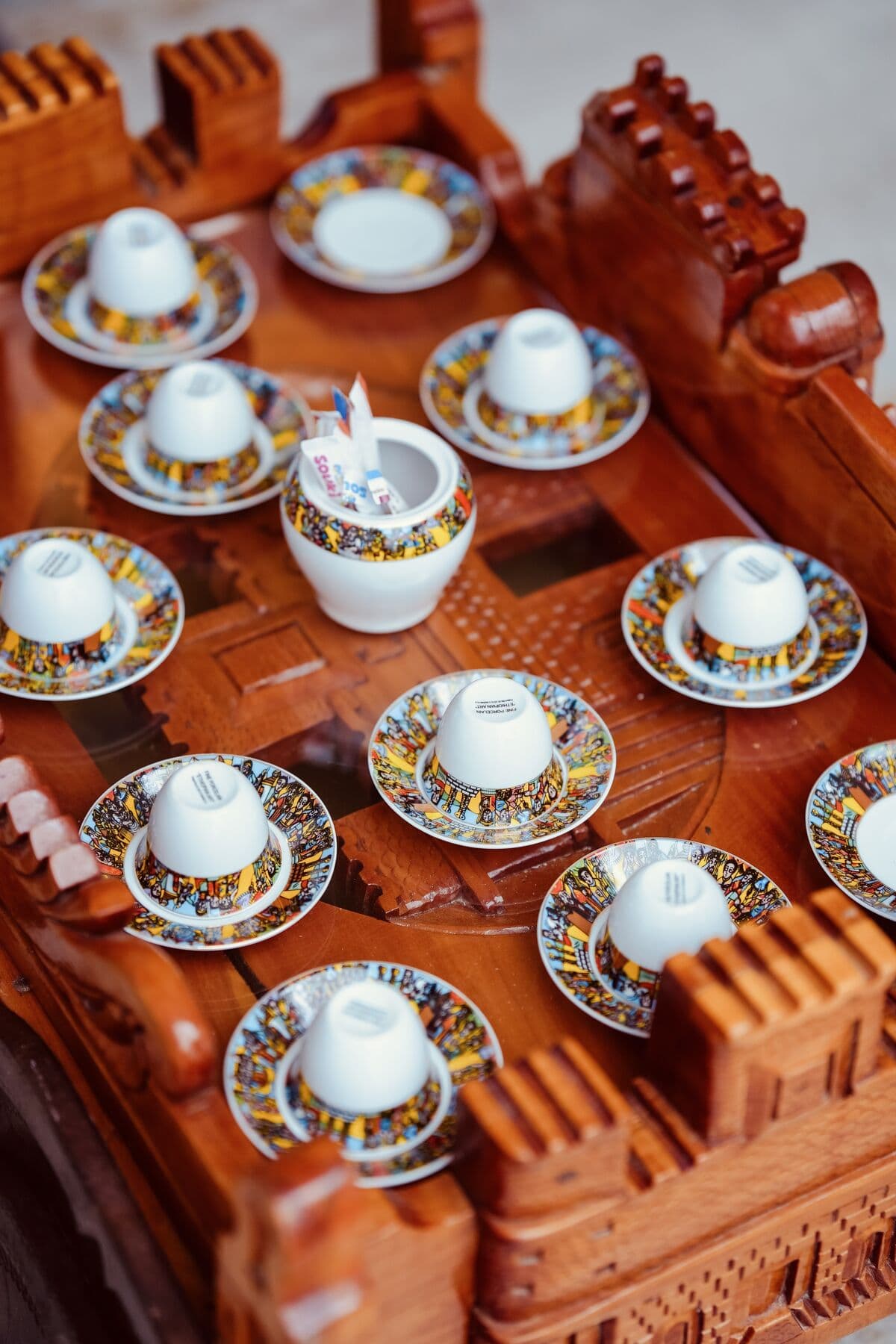
The rekebot is the carved wooden stand on which the coffee ceremony's cups are set, turned upside down while they wait to be filled. The cups themselves are called sini: small handleless cups, filled by coffee poured from a height out of the jebena. At Ge'eza, in Point E, both objects sit together on the table for the whole length of the ceremony.
What the rekebot looks like
The rekebot is a small wooden table or stand, often carved, on which saucers and cups are arranged before the service begins. The cups sit upside down, lined up, waiting for the moment they are turned over to receive the coffee. It is one of the first objects a guest notices approaching the ceremony table, even before any coffee has been poured.
Sini, cups built for small amounts
Sini are small handleless cups that hold only a sip or two at each fill. That size is not incidental: it is part of why the ceremony unfolds across three rounds rather than one large cup. Guests drink little each time, and stay at the table for a long while. Between rounds, the empty cups return to their place on the rekebot, ready for the next pour.
The pouring itself
Coffee is brewed in the jebena, the long-necked clay pot set over the embers. Once ready, it is poured from a height, in one continuous motion, into the sini set on the rekebot or held in hand. That motion keeps the grounds settled at the bottom of the jebena from spilling into the cup, and it is one of the most closely watched moments of the ceremony for guests experiencing it for the first time. The article jebena, the Ethiopian clay coffee pot covers the shape of the pot and its role in this exact gesture.
Three rounds, three pours
The rekebot and sini carry the ceremony through its three rounds: Abol, the first, the strongest; Tona, the second, more nuanced; and Baraka, the third, the gentlest, the one that closes the ritual. Each round is served in the same cups, rinsed and set back on the rekebot between pours. The article Abol, Tona, Baraka breaks down what changes from one round to the next, for anyone wanting to follow the shift in flavour.
Craft objects, without implying they are for sale
The rekebot and sini are traditional craft objects, of the kind sometimes found among the fine groceries and craftwork at the house. Nothing confirms that the rekebot or sini used during the ceremony are themselves for sale: for any question about what is available to buy, it is best to ask directly on site or by WhatsApp.
What you see at Ge'eza
During the ceremony, the table brings several elements together: the rekebot with its upturned cups, the jebena set over the embers, and the small brazier from which incense smoke rises. Together they form a scene many guests take in closely even before the coffee is poured, since the arrangement of objects is as much part of the ritual as the drink itself.
Two old objects, one shared rhythm
The rekebot and the jebena complement each other more than they compete: one keeps the cups ready, the other brews the coffee over the embers. Together, they give the ceremony its visible unfolding, from the first round to the final blessing, with no modern equipment standing in for either one.
Booking to see the service in person
To see the rekebot and sini in use, the full ceremony, at 7,000 F per person, takes about 45 minutes and is best booked 24 hours ahead, especially for a group. Booking goes through the coffee ceremony page or by WhatsApp at +221 78 660 07 07, with confirmation by the same channel or by phone.
Where these objects come from
The rekebot and sini belong to a long tradition of Ethiopian craftsmanship, in which carved wood and ceramics hold an important place among everyday objects. Their shape has barely changed over time: a stand sturdy enough to carry several cups, and cups small enough to allow for multiple rounds without wasting coffee. They are functional objects before they are decorative ones, even if their carving often catches the eye of guests seeing them for the first time.
A ritual seen as much as it is tasted
Many guests remember the look of the ceremony as much as its taste: the cups lined up on the rekebot, the incense smoke, the pour from the jebena. That visual side is nothing new: it has always been part of the ritual, and it is part of why the ceremony works so well for a group, where everyone watches the preparation before receiving their own cup. Even guests who have seen the ceremony before tend to watch the rekebot closely, since the exact arrangement of cups and saucers varies slightly from one sitting to the next, depending on the size of the group and the space available that day.
Frequently asked questions
What is the rekebot?
The often-carved wooden stand on which the coffee ceremony's cups are placed before and between rounds.
What are sini?
The small handleless cups used to serve the coffee, filled from the jebena at each round.
Why are the cups so small?
Because the ceremony unfolds across three successive rounds rather than one large cup: guests drink little at a time, over a long stretch.
Can I buy a rekebot or sini at Ge'eza?
Nothing is listed online for this: it is best to ask directly on site or by WhatsApp.