
Art · 6 October 2026
Ethiopian Orthodox Church Painting: Icons and Manuscripts
Icons, illuminated manuscripts, bold colours and large almond eyes: a guide to the painting of Ethiopian Orthodox churches, a living art that still feeds artists today.
The painting of Ethiopian Orthodox churches is an ancient tradition, recognisable by its bold colours, flat areas of paint, frontal figures and large almond eyes. It takes the form of icons on wood, wall paintings and illuminated manuscripts on parchment, often written in Ge'ez. This religious art is still alive, and it has fed many modern and contemporary Ethiopian artists.
A tradition tied to the liturgy
In Ethiopia the Orthodox Tewahedo Church has held a central place for centuries. The image has a precise function there: it accompanies prayer, teaches sacred stories and adorns the place of worship. Church painters work to handed-down codes that define attitudes, gestures, colours and the place of each figure.
That codified side does not mean uniformity. Workshops, regions and periods have developed different styles, and the eye can tell the manners of one monastery from another. We stay with general markers here, because each case deserves specialist study.
The forms: icons, walls and manuscripts
Icons are painted on wood, sometimes as triptychs or diptychs, and serve personal devotion as well as the liturgy. They show the Virgin and Child, saints, scenes from the Gospel.
Wall paintings cover the interior of many churches, with cycles of biblical scenes and saints surrounding the faithful.
Illuminated manuscripts, on parchment, carry religious texts in Ge'ez, the liturgical language, with miniatures that illustrate the stories. Ge'ez is also the origin of the name Ge'eza, and its script is presented in the article on the Geez script.
Colours and gaze
A few features strike the visitor: vivid colours (reds, yellows, greens, blues) laid in flat areas; sharp black outlines; faces seen frontally or in three-quarter view, with large almond eyes; figures whose size and position express importance. Scenes often set good against evil, with conventions readable to worshippers.
People like to speak of a gaze that follows you: it does not seek the realism of perspective, it seeks presence. It is an art of encounter, not of the window.
An influence on today's artists
Many Ethiopian artists of the 20th century and today have drawn on this heritage, in their colours, lines, motifs or subjects. Ethiopian modernity was built in dialogue with this tradition as much as with Western schools. For a glimpse of that dialogue, read the article on contemporary Ethiopian art, which covers Afewerk Tekle, Skunder and Mehretu.
That lineage explains why a look at church painting helps in reading a modern canvas: you find the same taste for bold colour, repeated motif, frontal figure.
Why talk about it in Dakar
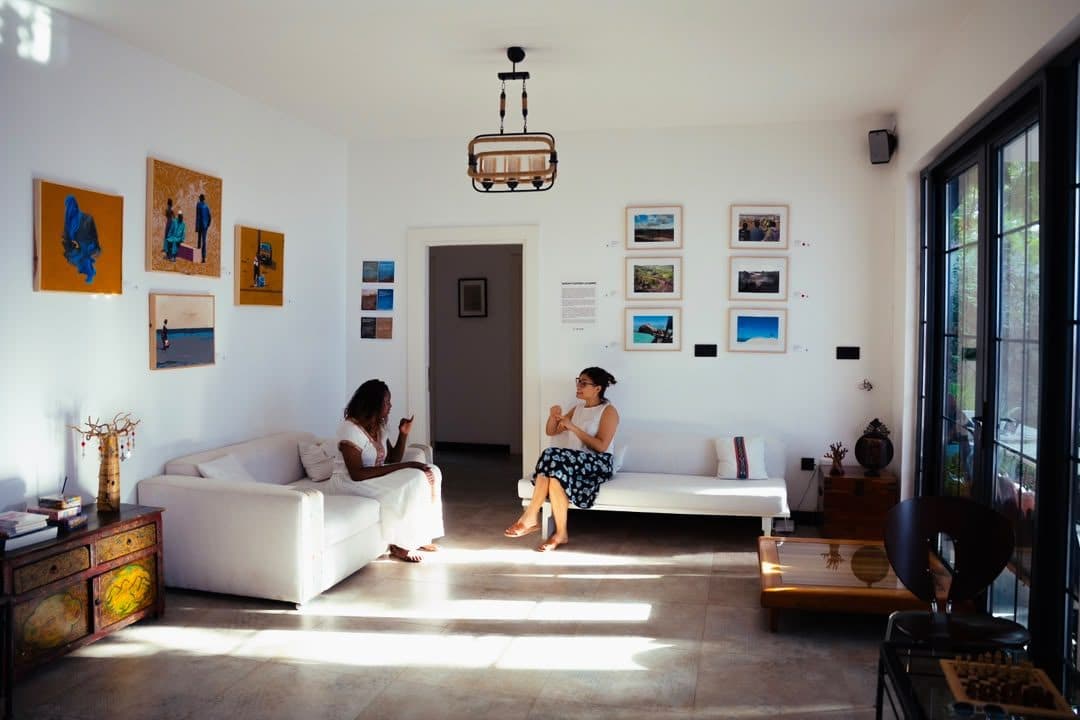
Ge'eza was born from the dialogue between Ethiopian and Senegalese civilisations, and the gallery lounge of the villa is one of its expressions. Talking about Ethiopian church painting gives readers a key to the art they can see in Point E, as to the culture expressed there through food and the coffee ceremony. The house does not show church icons in its current hang: to see what is on view, visit the gallery page.
How to look at an icon
- Find the main figure. Its size, position and colours single it out.
- Watch the eyes. Large and almond-shaped, they carry the intensity of the image.
- Read the colours. They are not decorative, they structure the scene.
- Look at the details. Clothing, crosses, ritual objects, repeated motifs.
- Take your time. These are images made to be looked at for a long while.
If you plan to visit churches and museums in Ethiopia, find out before you leave: visiting rules vary by place.
Visit Ge'eza
The house is open Tuesday to Sunday, 8am to 10pm, at 656 avenue Birago Diop in Point E. You can have an Ethiopian lunch, take a coffee and look at art, all in one place.
A painting still lived
These images are not museum objects: they are used every day in churches, during services and festivals. The Ethiopian feasts described in the article on Genna and Timkat give a glimpse. That is what makes this art strong: it is both heritage and practice.
Colours over time
Pigments and supports have evolved. Older workshops used natural materials prepared by hand, and parchment is a precious material. Today icon production continues, with varied materials. To know the exact techniques of a piece, turn to specialists.
Reading a narrative scene
Many church paintings tell stories in sequence, like a comic strip read by the eye. A scene may group several moments, with figures repeated to show the passing of time. Look for how the artist separates episodes: with a line, a change of colour, a architectural frame. The faithful, who know the stories, read them at a glance. A newcomer can follow the same path by identifying the main figure first, then looking at what surrounds it.
Learning more
To go deeper, look for books and exhibition catalogues on Ethiopian art, and for museum collections that hold icons and manuscripts. Reading about the stories behind the images, such as the lives of saints and the Gospel scenes, makes the pictures far easier to follow. A short visit to a gallery with a guide who can point out colours and gestures is also a pleasant way to start.
Frequently asked questions
What is Ethiopian church painting?
A religious art that includes icons on wood, wall paintings and illuminated manuscripts, tied to the Ethiopian Orthodox Church.
Why do the figures have large almond eyes?
It is a stylistic convention that gives the image strong presence, without seeking the realism of perspective.
What language are the manuscripts written in?
Mainly Ge'ez, the liturgical language of the Church.
Does Ge'eza show Ethiopian icons?
Not in the current hang. Contact the team to find out which works are on view.