
Art · 6 October 2026
Contemporary Sudanese Art: The Khartoum School and Creation in Exile
Modern Sudanese art grew out of the Khartoum School, with Ibrahim El-Salahi as a leading figure. A guide to that history, to creating far from home, and to the Sudan edition shown at Ge'eza in Dakar.
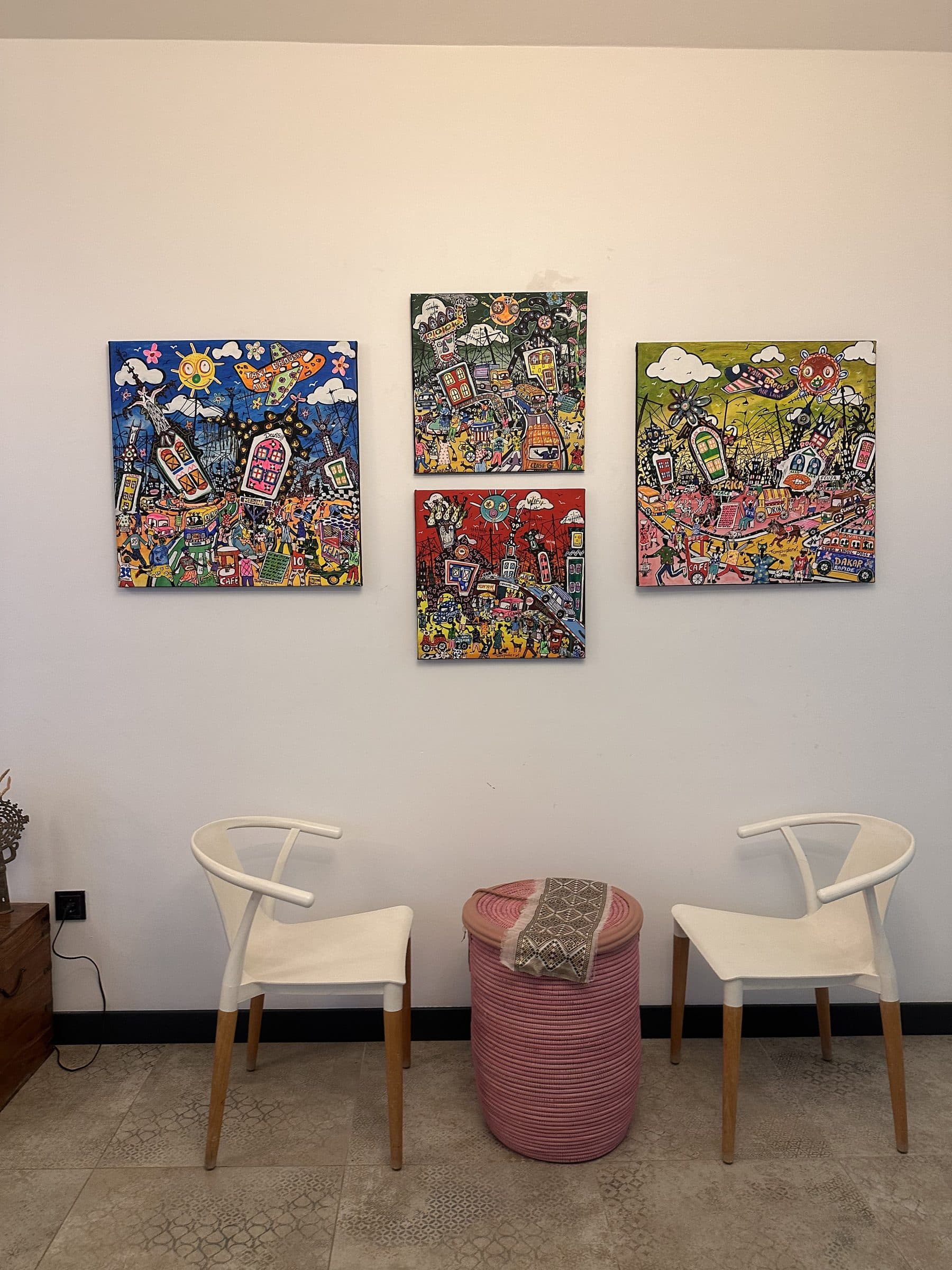
Modern and contemporary Sudanese art was built around the Khartoum School, a movement that appeared in the middle of the 20th century and sought to join African forms, the Arab-Islamic heritage and the languages of modernity. Its best-known name internationally is Ibrahim El-Salahi. Today part of Sudanese creation continues far from the country. In Dakar, Ge'eza devoted an edition of "A Country in the Spotlight" to Sudan, with works by Israa Hamad and Yasmeen Abdalah.
The Khartoum School
In the 1950s and 1960s, in Khartoum, a group of artists trained at the city's art school and, for some, abroad, looked for a path that was neither a copy of Europe nor a repetition of folklore. They drew on Arabic calligraphy, African motifs and the history of the Nile. The result, known as the Khartoum School, became one of the major currents of modern art in Africa and the Arab world.
The movement is not a single style. It gathers artists with very different manners who share one ambition: to invent a Sudanese visual vocabulary, rooted in the country and able to speak with the world. The Arabic letter becomes form, line and rhythm, on a par with figure or colour.
Ibrahim El-Salahi
Ibrahim El-Salahi, born in 1930 in Omdurman, is one of the most cited figures of this current. His work blends Arabic writing, African-inspired forms and finely controlled ink drawing. A retrospective was devoted to him at Tate Modern in London in 2013, which did a great deal for his recognition outside Sudan. We stay deliberately general about the rest of his career: readers who want the detail will find dedicated monographs and exhibition catalogues.
Other names come up often when this generation is discussed, among them Ahmed Shibrain and Kamala Ibrahim Ishaq. This article does not claim to cover the subject, only to offer entry points.
Creating far from home
Many Sudanese now live and work far from their country, so part of contemporary creation happens in exile or in the diaspora, in the Middle East, Europe, North America and other African countries. For artists this means a particular relationship with memory, place and connection. For audiences it means the works are sometimes found in unexpected spots: a living room, a café, a neighbourhood gallery.
We will not offer political commentary here. Our role is to look at the works, to show them, and to let the artists speak through them.
The Sudan edition at Ge'eza
"A Country in the Spotlight: Sudan" is the second edition of the format that invites one culture of the continent to Point E. Works by Israa Hamad and Yasmeen Abdalah were presented. The last highlight took place on Saturday 3 October 2026, from 11am to 9pm: a brunch with live music by Mildah, a small artisans' market, and entry at 2,000 FCFA.
To learn more about their work, the gallery team is happy to help. The best way to get to know them is to ask the gallery team. To understand what the format is and where it comes from, read the first article of the series, A Country in the Spotlight.
Why show Sudan in Dakar
Dakar and Khartoum are two African cities that know little of each other, separated by a continent. Bringing Sudanese works into a Senegalese gallery widens the field of references. It is also what a place that sees itself as a bridge between two Africas promises: to move the gaze from East to West, and not only between Ethiopia and Senegal. A brunch with music and an artisans' market do the rest: art is easier to share when you can sit down.
How to look at a Sudanese work
A few simple tips for a first encounter. Look for lines: calligraphy, geometry, repeated rhythms. Watch the colours: earths, blues, ochres, but above all how they are arranged. Ask yourself what the title adds. And put questions to the team, who can help place the works. For a comparison with another neighbouring country in the same spirit, you can read the article on contemporary Ethiopian art.
If you want to buy
The works shown at the gallery are available to acquire, with a price on request. Every work sold leaves with a certificate of authenticity signed by the artist. Payment is by Wave, Orange Money, bank card or on site, and the work can be collected in Point E or shipped outside Dakar on a quote. For information on a specific piece, visit the gallery or write on WhatsApp at +221 78 660 07 07.
A note on sources
The history of Sudanese art is rich and deserves specialist reading. To go further, exhibition catalogues, artist monographs and the programmes of museums that have devoted shows to the Khartoum School are the best sources.
Frequently asked questions
What is the Khartoum School?
A modern art movement that appeared in Sudan in the middle of the 20th century, combining African forms, Arabic calligraphy and Islamic heritage in a new visual language.
Who is Ibrahim El-Salahi?
A Sudanese artist born in 1930, a major figure of the Khartoum School, to whom Tate Modern devoted a retrospective in 2013.
Which Sudanese artists were shown at Ge'eza?
Israa Hamad and Yasmeen Abdalah, in the Sudan edition of "A Country in the Spotlight".
Is another Sudanese exhibition planned?
Dates are published on the events page once confirmed. Announcements are published on the events page.