
Dakar · 2 November 2026
Cafe Touba and Ethiopian Coffee: Two Coffee Cultures
Cafe Touba, Senegalese and roasted with Guinea pepper, and Ethiopian coffee, served through a ceremony, are two distinct traditions. Ge'eza, in Point E, does not serve cafe Touba but offers Ethiopian coffee, from a macchiato to the full ceremony.
Cafe Touba, Senegalese and roasted with djar, or Guinea pepper, and Ethiopian coffee, served through a ceremony with incense and a clay jebena, are two quite distinct coffee cultures found side by side in Dakar. Ge'eza, in Point E, does not serve cafe Touba, which is absent from its menu, but offers Ethiopian coffee in several forms: a macchiato for 4,000 F, an iced spiced latte for 4,500 F, or a full coffee ceremony at 7,000 F per person.
Cafe Touba, a Senegalese tradition
Cafe Touba takes its name from Touba, the holy city of Mouridism in Senegal. It stands out for being roasted with djar, Guinea pepper, a spice that gives it a distinctive aroma and a slight bite. Widely drunk across the country, it is often sold on the street by vendors who serve it hot and usually sweet, in a small cup. It is a popular, everyday drink, just as at home first thing in the morning as during a break in the day.
Ethiopian coffee, a longer ritual
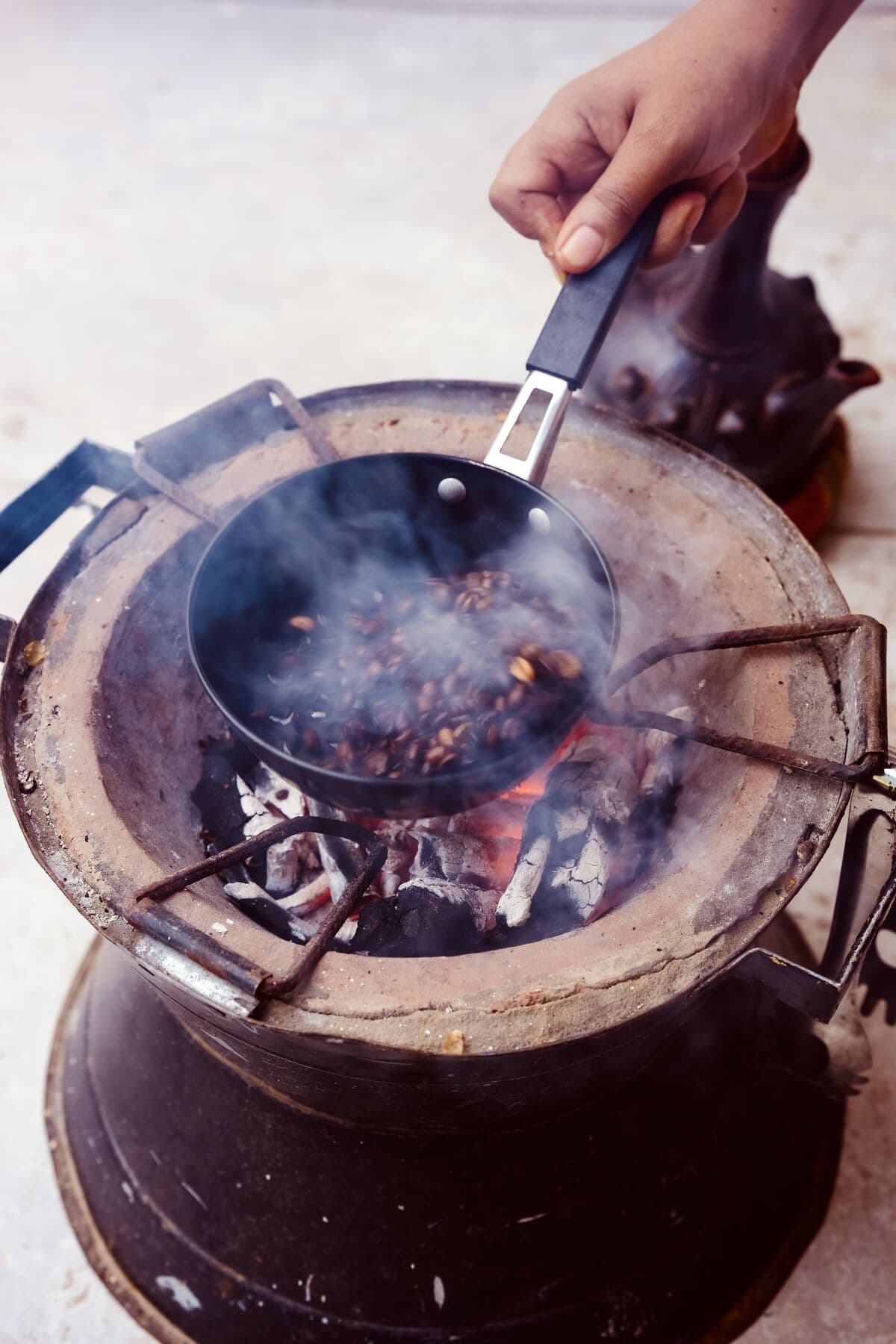
Ethiopian coffee, known as bunna, follows an entirely different logic. It is not a drink to grab on the go: the coffee ceremony, covered in our article on the origins of coffee in Ethiopia, turns its preparation into a shared moment. Green beans are washed, roasted in front of guests, ground by hand, then brewed in a clay jebena and poured in three rounds, Abol, Tona and Baraka. Incense burns throughout the preparation, and the ritual can run past an hour in some Ethiopian households.
One family, two different rituals
Cafe Touba and Ethiopian coffee share something beyond the drink itself: both sit inside a culture of hospitality where coffee is prepared and shared rather than drunk alone in a hurry. Our article on Ethiopian coffee and Senegalese attaya looks at how the coffee ceremony and Senegalese tea both follow a three-round logic, from strongest to mildest. Cafe Touba follows a different use, closer to an everyday drink than a welcoming ritual, but it belongs to the same family of drinks that shape a day and a meeting.
What Ge'eza offers: Ethiopian coffee, not cafe Touba
Cafe Touba is not on the menu at Ge'eza. The house, built around Ethiopian food and culture, instead offers several ways to drink Ethiopian coffee. For something quick, the Ethiopian macchiato is served at 4,000 F. For a cooler break, the iced spiced latte comes in at 4,500 F, among the other iced coffees on the menu. For the full experience, the coffee ceremony, with its three rounds, incense and house-made dabo, is served at 7,000 F per person and takes about 45 minutes.
Booking a coffee ceremony
The coffee ceremony is best booked 24 hours ahead, especially for a group, and confirmed on WhatsApp. Each round can also be ordered on its own for anyone who would rather taste a single stage of the ritual than the whole thing. Full practical details are on the coffee ceremony page.
Trying both traditions in Dakar
For anyone wanting to experience both coffee cultures during the same stay in Dakar, there is nothing stopping you from trying cafe Touba from a street vendor or a venue that serves it, then booking a coffee ceremony at Ge'eza for the Ethiopian side of things. The two drinks are prepared and enjoyed quite differently, and comparing them gives a broader sense of what coffee can mean across cultures.
Visitors who grew up with one tradition often notice the contrast first in the pace of the thing. Cafe Touba is built for a quick exchange with a street vendor, a cup handed over and finished within minutes before the day carries on. The Ethiopian coffee ceremony asks for the opposite: a seat, a stretch of time set aside, and a willingness to let the roasting, the grinding and the three rounds unfold at their own speed. Neither pace is better than the other; they simply answer different moments in a day, one built for movement and the other for pausing with company.
Why the distinction matters
Blurring the two traditions would flatten two different stories: a popular Senegalese coffee tied to a city and a religious practice, and an Ethiopian coffee built as a gesture of hospitality, with its own sequence and its own objects, the jebena, the rekebot, the small handleless cups. At Ge'eza, it is this second tradition that is on offer, in its full form as well as in quicker versions.
Coming to try Ethiopian coffee
To try Ethiopian coffee at Ge'eza, a table can be booked online or on WhatsApp at +221 78 660 07 07. The house is open Tuesday to Sunday, 8am to 10pm, closed on Monday, which leaves plenty of slots for a quick macchiato or a longer ceremony, on a weekday or over the weekend.
Frequently asked questions
Does Ge'eza serve cafe Touba?
No, cafe Touba is not on Ge'eza's menu. The house only serves Ethiopian coffee.
What gives cafe Touba its distinctive flavour?
Being roasted with djar, Guinea pepper, a spice that gives it a distinctive taste.
How much does the coffee ceremony cost at Ge'eza?
7,000 F per person for the full version, with three rounds, incense and dabo, over about 45 minutes.
Can I have a quick Ethiopian coffee without the whole ritual?
Yes, the Ethiopian macchiato at 4,000 F or the iced spiced latte at 4,500 F suit a quicker coffee.
Why is Ethiopian coffee served in three rounds?
The three rounds, Abol, Tona and Baraka, are three successive brews of the same ground coffee, from strongest to mildest.