
Guide · 6 October 2026
Business Lunch in Dakar: Choosing the Venue, Timing and Codes
How to make a business lunch in Dakar work: choosing the venue, how long to allow, the codes to respect, shared or individual dishes, and why to finish with coffee. Pointers and an address in Point E.
To make a business lunch in Dakar work, choose a quiet, easily reached venue, allow between an hour and a half and two hours, let the relationship settle before turning to the substance, and finish with coffee. At Ge'eza, in Point E, you can share a beyaynetu from 7,000 F for one person, or take the Senegalese dish of the day at 5,500 F, Tuesday to Friday at lunch.
Why lunch matters so much
In Dakar, as in much of West Africa, a meal is not an interlude before work: it is often where the work gets done. Trust is built at the table, in conversation, before a contract is signed. A first meeting in a boardroom can be efficient, but it is often the lunch that decides what comes next.
That means not treating the meal as a chore. A successful business lunch leaves room to ask after news, to talk about the city, the family, the projects, before getting into the figures.
Choosing the venue
Five criteria are enough.
- Access. Dakar traffic is dense at rush hour. Choose a place near one of your offices or your guest's hotel, and allow a margin. For an overview of what exists in Point E, see lunch in Point E.
- Quiet. You must be able to hear each other, with no loud music or noisy room. A terrace under the trees or a separate room helps.
- The menu. It should let everyone eat well: varied diets, familiar dishes and new ones.
- Discretion. For a sensitive subject, spaced tables beat a full room.
- Reliability. A service that keeps time. A lunch that drags because of the kitchen damages the meeting.
Think about booking too: for two to four people a call or message the day before is usually enough, but a weekend lunch or an important one is booked ahead.
Length and rhythm
Allow about an hour and a half to two hours. A lunch under an hour feels like business rushed through, and one over three hours tires everyone.
A rhythm that works:
- The first ten minutes: welcome, ordering, general conversation.
- The main dish: still talking about context, shared projects.
- The second half: you raise the main subject, once trust is in place.
- The coffee: you conclude and set the next step.
Avoid taking out documents on arrival. If a file is needed, wait until the main dish has passed.
The codes to respect
Flexible punctuality, but the host arrives first. The person inviting is there before the guests.
Greetings. Take the time to greet everyone and ask after their news. See also learning Wolof in Dakar for a few phrases.
Who pays. The host settles the bill, discreetly, at the end of the meal. Avoid discussing it at the table.
Diets and beliefs. Do not assume: ask beforehand whether your guest eats everything, and choose a venue with options.
The phone. Put away, silent. An important call is taken with an apology, away from the table.
Alcohol. Do not assume it is wanted. Many guests do not drink, and a venue with good non-alcoholic drinks lets everyone choose without explaining.
Shared or individual dishes
This is the most decisive choice for the atmosphere.
Individual dishes leave everyone in charge of their own plate. They suit very formal meetings, guests who barely know each other, or very different diets. At Ge'eza the Senegalese dish of the day at 5,500 F, with water or a local juice and attaya included, is a good example: mafé on Tuesday, thiéboudienne on Wednesday, supou kanja on Thursday, chicken yassa on Friday.
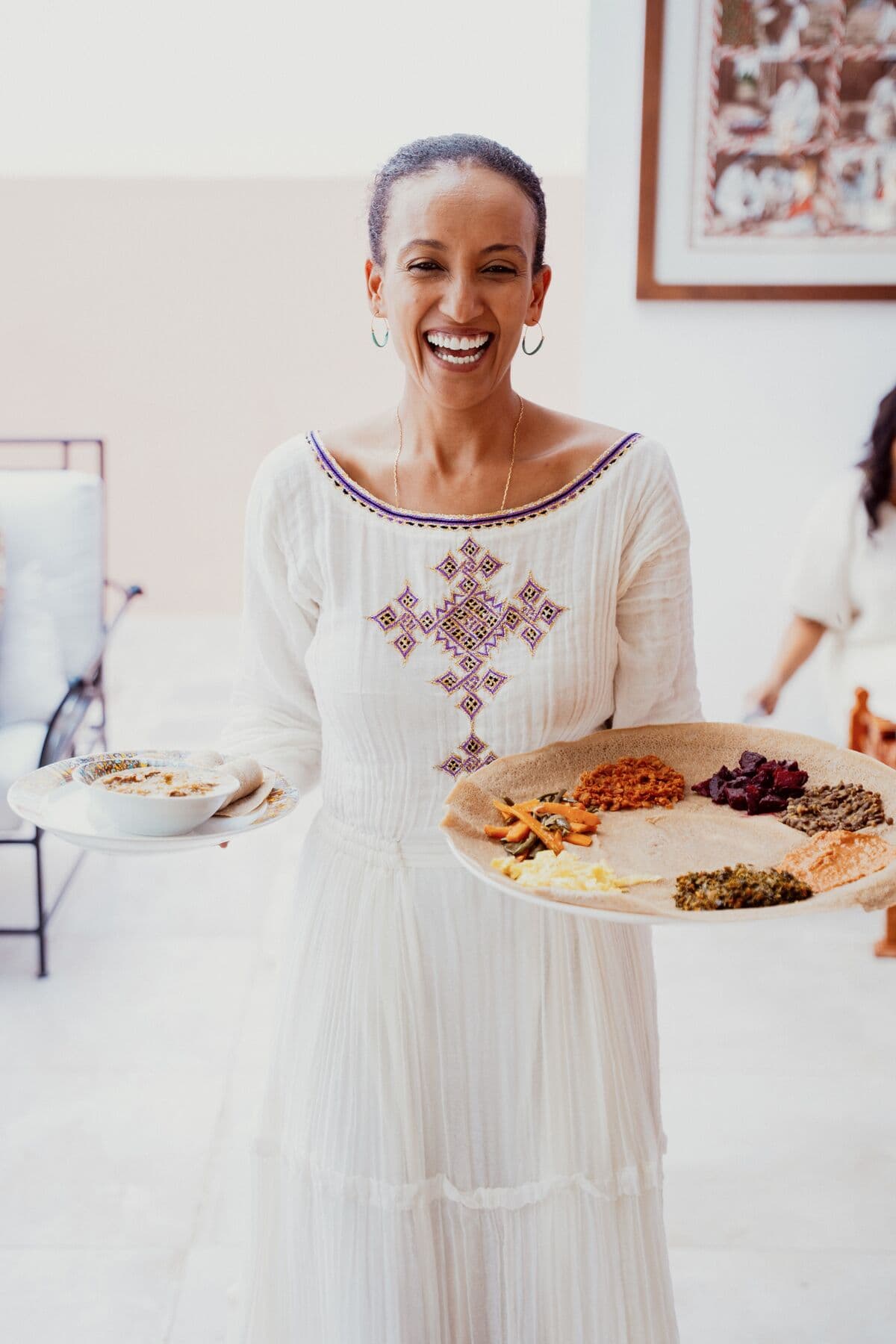
Shared dishes create closeness. One large dish in the middle, shared gestures, a common rhythm. Ethiopian food is especially suited: beyaynetu gathers seven vegan fasting dishes on one large injera, for 1, 2 or 3 people. For a table that wants meat, Ye Fisig Beyaynetu combines three fasting stews and one meat stew of your choice, at 10,000 F for two and 16,000 F for three. You eat with your right hand and injera, and the gursha gesture, the offered mouthful, creates a complicity few meals allow. It is also a good way to show a foreign guest something of the country, or the city.
Since the fasting dishes are vegan, a shared menu also avoids questions about diet.
Finishing with coffee
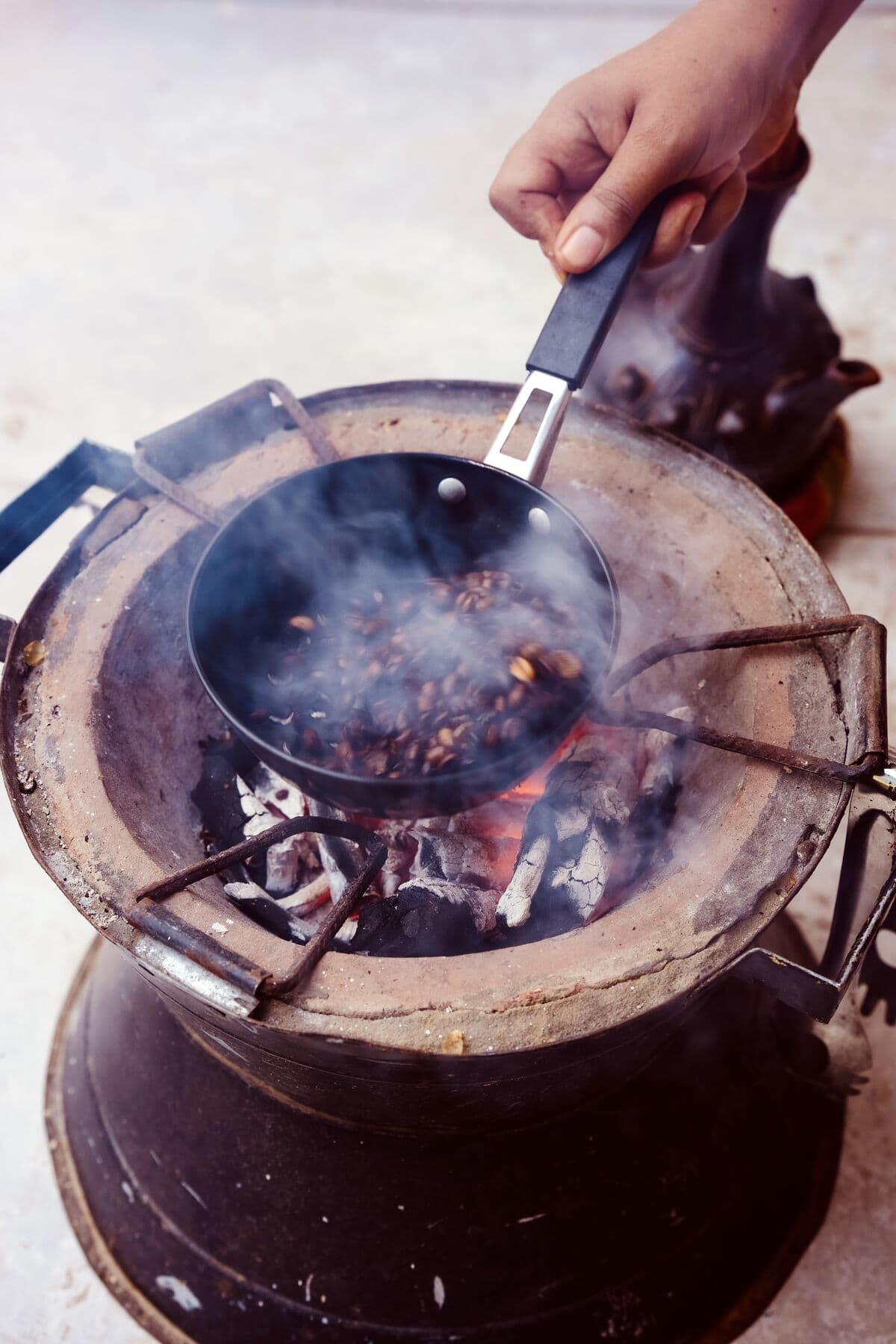
Coffee is the natural end of a business lunch: it is the moment to conclude, to say what remains to be said. At Ge'eza an Ethiopian macchiato at 2,500 F makes a quick conclusion. If the schedule allows, the coffee ceremony, 5,000 F per person and about 45 minutes, brings a calm that eases the end of a negotiation. It is best booked 24 hours ahead, especially for a group, with a WhatsApp confirmation. See the coffee ceremony as a language of hospitality.
After the lunch
A thank-you message the same day is appreciated, with a short summary of what was agreed. A simple gesture also remains: offer to return the invitation, another day, in another place.
Booking at Ge'eza
The house is open Tuesday to Sunday, 8am to 10pm, at 656 avenue Birago Diop, Point E. For a business lunch you can book online or write on WhatsApp at +221 78 660 07 07, stating the number of guests and any dietary needs.
Frequently asked questions
How long should a business lunch in Dakar last?
Between an hour and a half and two hours, including coffee.
Who pays for the lunch?
Usually the person who invited, discreetly at the end of the meal.
Is a shared menu suitable for a professional meeting?
Yes, if it suits your guests. It creates closeness. For a very formal meeting, individual dishes may be better.
Do I need to book?
For an important lunch, yes. At Ge'eza, booking is online or by WhatsApp.