

Guide · 27 October 2026
Flying Home With a Painting Bought in Dakar
Taking a painting bought at Ge'eza's gallery home by air: check your airline's rules, protect a framed work on paper or a canvas, keep the invoice and certificate close, or choose shipping on a quote instead.
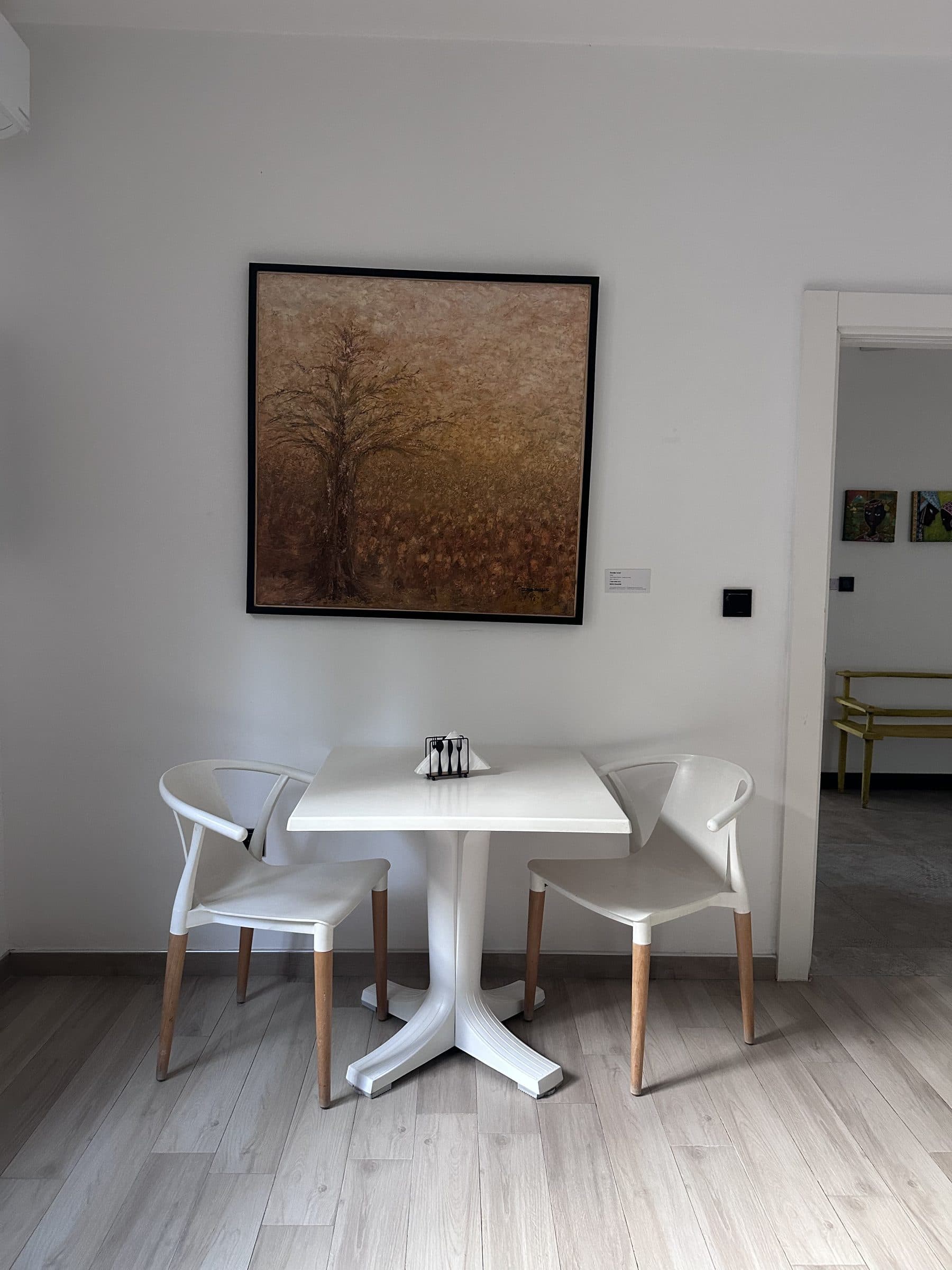
To fly home with a painting bought at Ge'eza's gallery, three things matter before departure: checking your airline's own rules for cabin or checked baggage, protecting the work according to its medium (canvas or framed paper under glass), and keeping the invoice and the certificate of authenticity handed over at purchase close at hand.
Checking your airline's rules before you leave
Every airline sets its own size and weight rules for cabin baggage, and some accept a framed piece as an extra item while others do not. Rather than guessing, the safest approach is to call your airline's customer service before departure, describing the painting's exact dimensions, framed or not, and asking whether a size as large as a 100 x 100 cm canvas or bigger can travel in the cabin or must go in the hold. These rules vary from one airline to the next and from one period to the next: no single rule applies to every flight.
An unframed canvas, easier to pack
A canvas stretched on a frame without glass stays relatively light and can travel rolled inside a rigid tube for larger sizes, or protected by a flat board for smaller ones. Several works at the gallery, by Ibou Diagne or Tampidaro for instance, are canvases of this kind, at sizes such as 70 x 90 cm or 100 x 100 cm. In every case, rigid packing with protected corners limits the risk of a crease or a knock along the way.
Paper under glass, more fragile
Saadio's works on kraft paper, framed under glass, call for different handling: the glass adds weight and a risk of breakage that canvas does not carry. For this kind of piece, carrying it as hand luggage, handled with care, protects it better than checking it with other bags in the hold. If your airline will not allow this size in the cabin, shipping is worth considering rather than risking a poorly protected trip in the hold.
Keeping the invoice and certificate with you
Every work sold at the gallery comes with an invoice and a certificate of authenticity signed by the artist. Both documents should travel with you, on paper and as a photo on your phone, never only in checked baggage that could be delayed or lost. They serve both as proof of purchase and proof of authenticity, useful at a check or for insurance once you are home.
Asking the gallery for packing
Before leaving Point E with your painting, ask the team for packing suited to the work's size and medium: a rigid box, protective foam, and clear markings if the piece will be handled by anyone else along the way. This step, simple to arrange on the spot when you collect the work, saves you from improvising packing at a hotel or an airport at the last minute.
Checking the customs side too
Export and import rules vary by destination country, and they can change. Senegal has ratified the 1970 UNESCO convention on cultural property; for a contemporary work bought at a gallery, the exact export process is not publicly documented in detail. The guide Taking Artwork Out of Senegal covers this point: it is best to check directly with your carrier and the relevant authorities before travelling, stating that the piece is a contemporary work accompanied by an invoice and a certificate.
The alternative of shipping
For a large canvas, or simply to avoid any baggage constraint, shipping out of Dakar on a quote remains an option offered by the gallery. The guide Shipping Artwork From Dakar covers this alternative, meant for sizes that do not fit easily into luggage, or for buyers who would rather not handle it themselves while travelling.
Thinking about the return flight ahead of time
Some travellers only think about the painting once they are already at the airport, with a flight to catch and little time to sort out an unexpected large item. Deciding at the gallery, before leaving Point E, whether a work will travel as luggage or by shipping avoids that last-minute scramble, and leaves enough time to call the airline or arrange a quote calmly.
Choosing between luggage and shipping
For a small or mid-size work, such as the 60 x 50 cm kraft paper pieces or the 70 x 90 cm canvases, cabin luggage is often the simplest route, provided the airline allows it. For a large size, such as a 150 x 150 cm or 180 x 120 cm canvas, shipping arranged by a specialist carrier avoids the complications of travelling with luggage, even if it takes a little more time and needs a quote first.
Before you leave with your painting
Three checks are enough before leaving Dakar with a work: your airline's rules for that exact size, packing suited to the piece arranged at the gallery, and the invoice and certificate within reach. For any question before your flight, write on WhatsApp at +221 78 660 07 07 or email geezacultures@gmail.com, naming the work's title and your flight date.
Frequently asked questions
Can a painting always travel in the cabin?
It depends on the airline and the work's size: check directly with your carrier before departure.
How do I protect a framed paper work during the flight?
By carrying it as hand luggage rather than checking it, with rigid packing supplied by the gallery.
Should I keep the invoice and certificate in my luggage?
Yes, on paper and as a photo, never only in checked baggage.
What if the painting does not fit in my luggage?
Shipping out of Dakar on a quote, arranged by the gallery, remains the alternative.